I KNEW KENSAL GREEN BEFORE ITS RISE

St__John_the_Evangelist,_Kensal_Green_-_geograph_org_uk_-_998127william-makepeace-thackeray
I KNEW KENSAL GREEN BEFORE ITS RISE
I knew Kensal Rise, or is that Kensal Green
When upward mobile and genteel
Were hardly to be seen
When Harlesden was such a pain
And we all avoided poor Scrubs Lane.

The Harrow Road was long and lonely
Fit for trucks and tractors only
Most estate agents did a swerve
And said that sellers had a nerve
To say it was just off Queens Park
Where gentrified had made its mark

The cemetery stood gaunt nearby
With its patchwork bricks
And walls so high
Though Ladbroke Grove might still be seen
By standing on a mausoleum

Queen Victoria and Mark Twain
To Kensal Rise they both came
And a library they did endow
That’s the talk of London now
Today there’s cafes, bars, boutiques
And Chamberlayne’s the hippest street
Where Lily Allen and Sophie Dahl
Rub shoulders with the great and small
And Ian Wright and Zadie Smith
Have made the area quite a hit.
I wonder if they all will stay
Like Harold Pinter to decay
With William Makepeace Thackeray

MY FIRST DRAFT IS IT

1969-Ex-jockey-turned-aut-0321956-Queen-Elizabeth-II-a-023

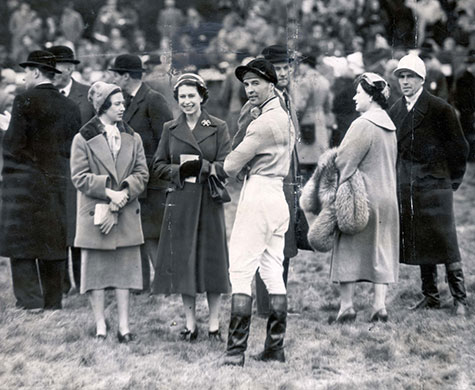
Books write authors as much as authors write books. So says Dick Francis, top-selling writer of horse-racing thrillers. The process of producing fiction is a mystery which I still do not understand. Indeed,as the years go by I understand it less and less, and I am constantly afraid that one day I will lose the knack and produce discord, like a pianist forgetting where to find middle C.
Francis, a top- class jockey before turning to writing is best remembered as the rider of the Queen Mother’s Devon Loch, who collapsed less than one hundred yards from the post in the Grand National, with the race at it’s mercy. People often ask me where I get my ideas from, and the true answer is that I really don’t know. They ask me how or why I write the way I do, and I don’t know that either. It seems to me now that one can’t choose these things and that one has very little control over them.
The author of such books as Whip Hand, For Kicks, Bonecrack,and Dead Cert – which was the first of his books to be filmed – says this about the technique of writing; I listen in a slight daze to people talking knowledgeably of ‘first drafts’ and ‘second drafts’, because when I first began to write I didn’t know such things existed. I also didn’t know that book authors commonly have ‘editors’, publishers assistants who tidy the prose and suggest changes of content. I thought that a book as first written was what got (or didn’t get) published. I still write that way. My first draft is IT. I can’t rewrite to any extent. I haven’t the mental stamina, and I feel all the time that although what I’m attempting may be different, it won’t be any better, and may well be worse because my heart isn’t in it. My publishers have mournfully bowed to this state of affairs.
He describes his method thus; When I write any one sentence, I think first of all of what I want it to say. Then I think of a way of saying it. At this point I usually write it down in pencil in an exercise book, then wait to see if a new shape of words drift into my head. Sometimes I rub bits out and change it, but once the sentence looks all right on paper I go on to the next one and repeat the process. It’s all pretty slow as sometimes one sentence can take half an hour. On the following morning I read what I’ve written and if it still looks alright I go on from there. When I have done a couple of chapters I type them out and it is this typescript that goes to the printers.
In January, he sits down to write, staring down the barrel of a deadline. “My publisher comes over in mid-May to collect the manuscript, and it’s got to be done. Each one, you think to yourself, ‘This is the last one,’ but then, by September, you’re starting again. If you’ve got money, and you’re just having fun, people think you’re a useless character.”
Dick Francis wrote more than 40 novels in this manner and they all became international best-sellers. He was one of my favourite writers and I have read most of his books over the years. He struggled with writing his books for most of his writing life, but he managed at least one a year for over forty years. That says something about his dedication to his craft. No one ever said it would be easy!

Dick Francis died in 2010, aged 89

I WONDER WHAT THEY WILL SAY


I WONDER WHAT THEY WILL SAY 

I wonder what they will say of me when I am gone?

It was him that penned those lines, you know

The ones about choking the chicken.

Ah, poor Katie Doyle never lived that one down!

And the lies he told in that Altar Boy book he wrote

Just as well his poor mother wasn’t still around…


Then there was that tale about the Kray Twins

How he walked and smoked with them

On remand in Wormwood Scrubs if you don’t mind!

How they didn’t seem nearly as bad as they were painted

In fact he almost said they were kind!


I wonder what they will say of me when I am gone?

Perhaps they will say nothing


BOOK REVIEWS ON THE STREET

Homeless Bookworm

Philani is a homeless man in his mid-twenties in Johannesburg, South Africa. Many people in his situation simply stand at corners begging. And that can sometimes meet basic needs…but it certainly doesn’t set a person apart or motivate people walking or driving by to donate.

But Philani does it differently. Every day he takes his ever-changing library to a different corner and sets up a sort of impromptu literary discussion group and bookshop.

For anyone interested, he will review his books and then you can buy one from him. In this way, he raises money for himself and his homeless friends as well as spreading happiness.
Philani says;

‘Reading is not harmful. There’s no such thing as harmful knowledge. This thing is only going to make you a better person.’

And if he has a kids book you’re interested in, it’s free, so that you can give it to a child.

Ride on ,Philani my friend!

See all my books for sale on amazon @ http://www.amazon.co.uk/Tom-OBrien/e/B0034OIGOQ/ref=sr_tc_2_0?qid=1388083522&sr=1-2-ent


DAWNING

DAWNING

 ‘Silly old fool’, someone

Shouts in your wake

And in the brilliantly-lit

Cube of time ‘old’ is dangled

Before your eyes


And won’t go away


She called you old! And

In the instant it takes you

To turn around and see

The solitary young woman

Bend down to retrieve her parcel

It dawns on you that you are

Nearer the end than the beginning


Much nearer


It comes, not creeping in the dark,

But galloping unstoppably

Over the horizon

And you never see it


Silly old fool


JESUS SAVES


I wrote this piece of doggerel whilst watching a boring football game last night


JESUS SAVES

 There is no doubt it is a penalty

A trailing leg caught the number nine

And upended him right on the spot.

Jesus shakes his head;

So stupido, our centre half

So bloody stupido.

Jose de Jesus will be our saviour

He tells himself

Blessing himself three times

Calling on his grandmother, his grandfather,

The Holy Ghost, Castro, Pancho Villa

And all the saints in Christendom.


The penalty taker glares at him

If looks were bullets he would be finito

He is stupido too, he thinks

Smiling his little smile.

He sways this way on jelly legs

Feints that way and flops his arms

The ball is struck, the aim is fine

But Jesus has read the striker’s line

And….oh yes….

Jesus saves – this time

UNTITLED


UNTITLED

 An unmanned comet passed

By my window last night

Steering by our moon

Stealing love


Its journey will be long


 from my new collection of poetry ’67’ – http://www.tinhuttalespublishers.co.uk/67/


THE SONGLINES

SONGLINES


Labyrinth of impossible pathways

Meandering across Australia

Singing the Aborigines home

Singing out the names of every

Bird, bee and tree

Singing rook and river

Singing you and me

Singing all the world

Into being.


A dreaming track

A path across the land

Or sometimes the sky

Creator-Beings dreaming

Songs, stories, dances, paintings

Petrosomatoglyphs on the land

Leaving huge footprints behind

Navigating vast distances

Through the parched interior

Language no barrier

Melodic contours in song

Passing over the land

Rhythmically beating out the jives

Where the spirits of unborn children

Sing to keep the land alive


Chatwin tells us how it was

The songlines stretching across the eons

People singing their lives into existence

Following signs their ancestors

Had tuned to perfection.

Their roads invisible to us

No traces we could follow

No marks we could discern

No bulldozer dented this terrain

No tarmac spread for others gain

 No buildings stacked with pure disdain

To leave wrecked nature in their wake

The lines were left to all for free

If our blinkered eyes could only see.


Yarralin, Walujapi

Black-Headed Python

Rainbow Serpent

Native Cat Dreaming

Arranda, Kaititja, Kukaja

Unmatjera, Ilpara

Ley-di-ley-di-ley

Long lines

Ley-di-ley-di-ley

Songlines


BAD POETS SOCIETY


Wordsworth wrote The Prelude

And it was all right

But it was a prelude

To a load of s***e

(Kingsley Amis)

Amis clearly wasn’t a fan of Wordsworth! Is writing bad poetry easier than writing good poetry? Probably not – and it’s just as time-consuming. William McGonagall could probably confirm that!

William Topaz McGonagall  was a Scottish weaver, poet and actor. He won notoriety as an extremely bad poet who seemingly couldn’t care less of his peers’ opinions of his work.

He wrote about 200 poems, including his notorious “The Tay Bridge Disaster”, which are widely regarded as some of the worst in English literature. Groups throughout Scotland engaged him to make recitations from his work and contemporary descriptions of these performances indicate that many listeners were appreciating McGonagall’s skill as a comic music hall character. Collections of his verse remain popular, with several volumes available today.

McGonagall has been acclaimed as the worst poet in British history. The chief criticisms are that he is deaf to poetic metaphor and unable to scan correctly. In the hands of lesser artists, this might generate dull, uninspiring verse. McGonagall’s fame stems from the humorous effects these shortcomings generate. The inappropriate rhythms, weak vocabulary and imagery combine to make his work amongst the most unintentionally amusing poetry in the English language. His work is in a long tradition of narrative ballads and verse written and published about great events and tragedies, and widely circulated among the local population as handbills. In an age before radio and television, their voice was one way of communicating important news to an avid public.

He died penniless in 1902 and was buried in an unmarked grave in Greyfriars Kirkyard in Edinburgh.

The Tay Bridge Disaster

Beautiful Railway Bridge of the Silv’ry Tay!/ Alas! I am very sorry to say /That ninety lives have been taken away/ On the last Sabbath day/ of 1879/, Which will be remember’d for a very long time/.’Twas about seven o’clock at night,/And the wind it blew with all its might,/ And the rain came pouring down/, And the dark clouds seem’d to frown/, And the Demon of the air seem’d to say-“/I’ll blow down the Bridge of Tay /-

There’s more – a lot more – unfortunately!

William McGonagall.jpg 

FRIGHTENING THE CROWS


            FRIGHTENING THE CROWS

            I once knew a man

            Who frightened crows for a living.

            In between, he brewed cheap beer

            And stole old books.

            He cycled the universe

            Looking for answers;

            All he found was a cold grave

            When he was thirty nine.


my new collection of poetry is now available @  http://www.tinhuttalespublishers.co.uk/67/