LOVE POEM FROM BONMAHON

Image


LOVE POEM FROM BONMAHON


            God in his heaven never bettered this;

            Never hit perfection more square-on.

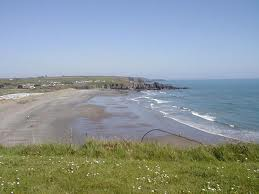
            Rugged cliffs lip the strand,

            Opening to fields behind,

            The Atlantic, white-layered,

            Sweeping into the bay,

            Its hurry washed-out

            By the tug of sand, gently rising,

            Before it.


            A tangle of marram crowns the dunes,

            Tousled, like windswept hair;

            Whilst, on the slopes nearby,

            A line of white cottages

            Vie for prominence with the old church


            Yet, it is the call of the waves

            That steals most of the aces;

            Those rider-less white horses

            Sweeping relentlessly in,

            With their whispering lisps;

            ‘I love you, please don’t go,

            I love you please don’t go’


            And I, watching the ebb-tide dragging them back,

            Silently mouthing in their wake;

            ‘She loves me, she loves me not,

            She loves me, she loves me not…’


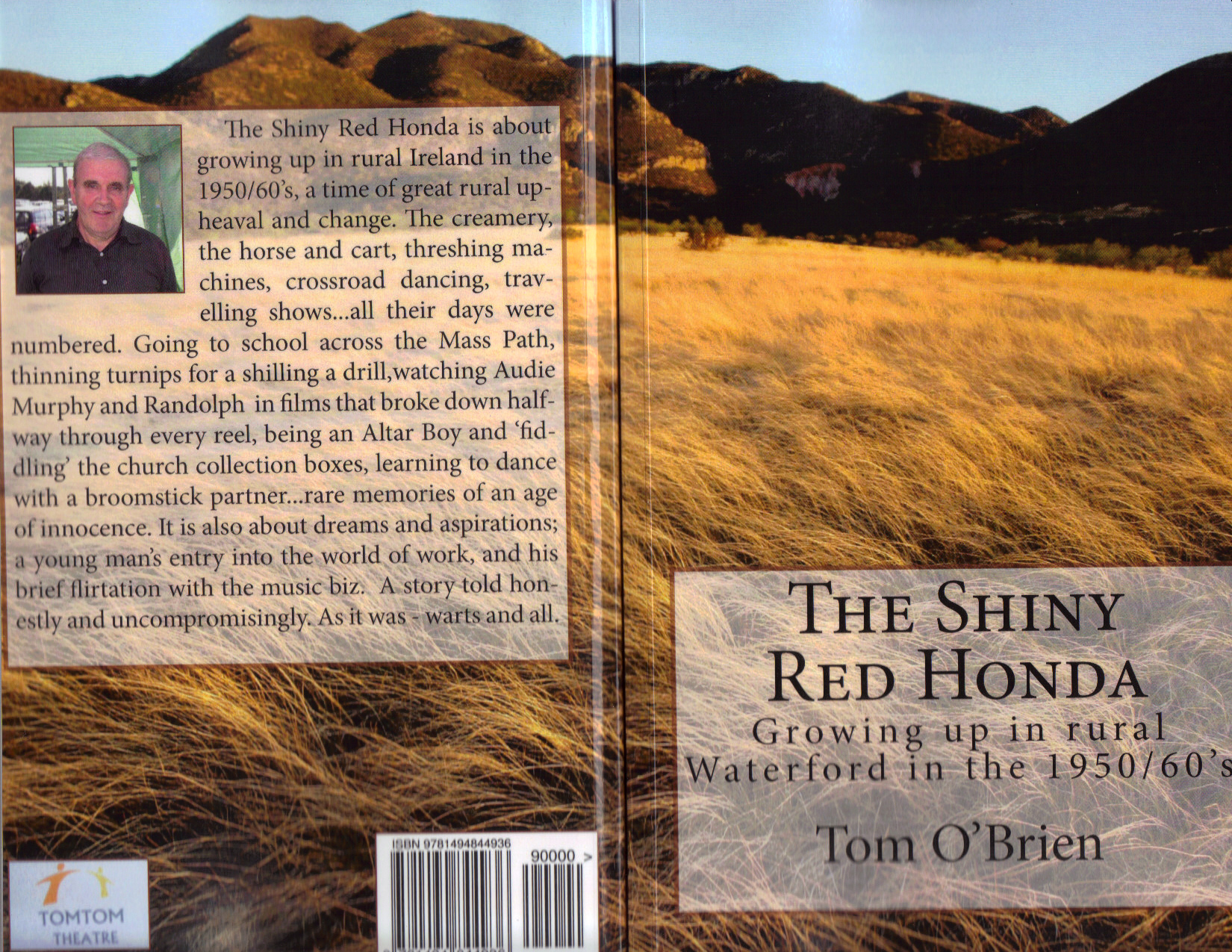
THE SHINY RED HONDA – NEW PAPERBACK

Image

Visit my Amazon book page http://www.amazon.co.uk/Tom-OBrien/e/B0034OIGOQ/ref=sr_tc_2_0?qid=1388083522&sr=1-2-ent
GUINNESS IS GOOD FOR YOU

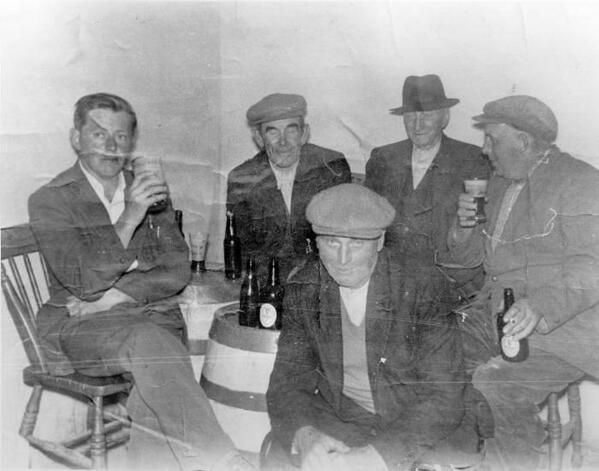
This old photo – courtesy of Waterford Co. Museum – show locals enjoying their bottles of Guinness in Ciss Kirwan’s pub in Bonmahon Co Waterford, Ireland c 1950.  I grew up not half a dozen miles from Bonmahon, and I think it is my favourite spot in the world. Well it was until we visited LA last year! A seaside village in what is now called The Copper Coast region, it was in its heyday in the 19th C a thriving copper-mining area. Then the copper ran out and all that eventually was left was a warren of mineshafts and a decaying main street where most of the houses had either fallen down or were knocked down. Once the copper had gone most of the people left too.

I t was our mecca in the summer though; we cycled there most Summer Sundays, content to play football and other games on the long sandy beach or climb the pathways to the gently rising cliffs at either end of the village. The river Mahon split it in two and a cumbersome old metal bridge also provided further opportunites to clamber  between the struts and girders hidden beneath the  tarmac and cement laid on top of them.

As we got older we took our transistor radios with us and listened to the velvet tones of Brian Hyland as we sat on the rocks overlooking the bay.  I only met you just a couple of days ago/I only met you and I want your lovin’ so Jeannie come lately, you may have come lately/ But you’re the one for me. Or Susan Maughan.  I want to be Bobby’s girl, I want to be Bobby’s girl/ That’s the most important thing to me/ And if I was Bobby’s girl, if I was Bobby’s girl/ What a happy faithful girl I’d Be.Of course it wouldn’t be long before the girls appeared, insinuating themselves between us. I am sure it was all planned where they would sit, but at the time we didn’t have sense enough to cop on, thus many an opportunity of a bit of innocent canoodling was missed. Part of the enjoyment was going to Ciss Kirwan’s and stuffing ourselves with bottles of Cidona and bags of Tayto crisps. Image

Yes, glory days.

THE NIGHT THE MUSIC DIED

Image 

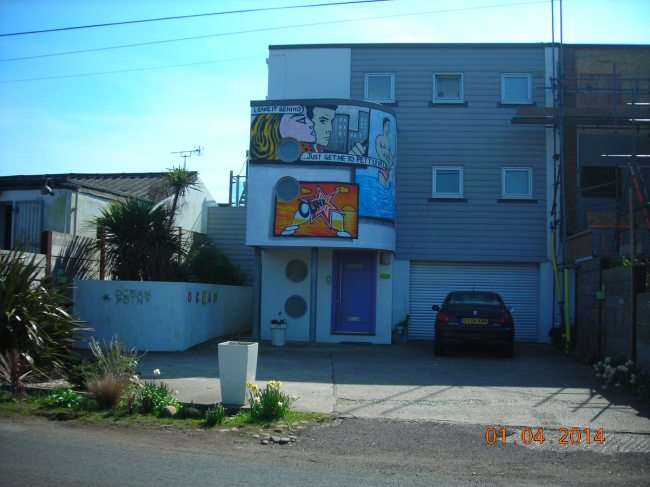
                                                                         Pett Level,Winchelsea


            THE NIGHT THE MUSIC DIED


            He lay in the box quite comfortably

            His waxen face staring into infinity

            Looking much better in death

            Than he ever had in life.

            It was all that I could do to peer

            At him through slatted fingers

            From the back of the room;

            The ever-present smell of tanning

            And leather aprons absent now;

            More than forty seeping years of it

            Scrubbed away one last time


            His moped – a natural progression from pedal power

            When his legs gave out –

            Lay discarded in the coal shed

            At the back of the house.

            (No driver you see, and mother still had the shopping to do)

            He dug turf, cut down young Sally trees,

            And turned over his bit of stony ground endlessly.

            In summer he clipped sheep slowly

            With a machine bought by post from Clerys,

            Carefully stowing it away in its box

            When the shearing was done.


            The clay pipes he sucked on – their broken stems

Held together with blood pricked from his thumb –

            Were redundant now

            And his three bottles of Sunday-night Guinness

            Would stand corked under the counter evermore.

            Who would dance half-sets with her now?

            My mother enquired of no one in particular,

            The smoky saloon bar stunned that the music had felled him

            Knocked him to the floor in the middle of the tune.

            He lay there with a smile on his face

            Knowing it was over

            And I never got to know what was on his mind.


            We put him in the ground

            And sadness trickled through me

            Like a handful of sand through my fingers.

            Later, everyone stood around

            Eating sparse ham sandwiches

            While I stood there, dry-eyed;

            He was a great man they all said

            Slapping the back of my overcoat;

            Sure he gave forty years to that tannery


            And what did it give him?

            I wanted to shout to the throng;        

            A gold watch and a tin tray

            And both had his name spelled wrong


Visit my Amazon book page http://www.amazon.co.uk/Tom-OBrien/e/B0034OIGOQ/ref=sr_tc_2_0?qid=1388083522&sr=1-2-ent


CASSIDY’S CROSS

My latest book, now available on Amazon.

Visit my Amazon book page http://www.amazon.co.uk/Tom-OBrien/e/B0034OIGOQ/ref=sr_tc_2_0?qid=1388083522&sr=1-2-ent

Image

A TRUE STORY


OLD ACQUAINTANCE


I see they have sent him down – again

A two stretch this time

I sold a typewriter for him once

And got six months for my trouble

(he got three, but swore it was my idea)


Then there was the time he

Asked me to burn his house down

‘Two hundred quid’ he said ‘easy money’

‘The insurance won’t twig it’

(when I declined, he did the job himself)


After that we lost contact for several years

He removed his wife and daughters to another town,

Where he was just as big a bastard – to them –

And to the world in general


Drinking, gambling, big-mouthing and beating,

Mostly his wife,

Till she put a slit near his throat

With a carving knife


Left to his own devices

He hung misery about him like a shroud;

He went to Knock for a week

And returned a changed man

Flowers from Interflora, presents for the girls,

Flannel for everyone else.

She relented of course.


They don’t speak much about him in the town now

A nudge and a wink

When his wife appears;

‘She must have known what was going on…

Doing that with his girls….

And she had him back!’

 Image

IRISH AMERICAN POST INTERVIEW

IRISH AMERICAN POST – QUESTION & ANSWER SESSION


What are some of your inspirations for your plays and books? Are they of a biographical nature?

Of course my writing is autobiographical to some degree. I don’t think a writer can write without putting something of himself into his work, be it novels, plays, short stories or whatever. But I also think reading plays a big part; to write well I think you have to read well. By that I mean read the best writers, both contemporary and historical, and try and figure out how they did it.  I love Ernest Hemingway for example; I think he was the greatest writer of the 20th century and have read everything he wrote – many times. I am always finding something new in his works. Ernest was a very conscientious writer; he wrote every morning for 4 or 5 hours without fail; he was also a very proud writer, and when he found his writing powers fading at the age of 60 he blew his brains out with a shotgun rather than carry on. That’s how much writing meant to him

When did you realize that you wanted to write as a profession?

I had always been a bit of a closet writer throughout my life, writing bits and pieces sporadically –  then discarding them as rubbish. It wasn’t until about 20 years ago that I decided to give it a proper go. I was in my mid forties then; I would write for a couple of hours every night after work in our attic – I floored it and made it into my writing den – and found that the discipline of regular writing improved my work tremendously.  I also maintained that it kept me out of the pub – it didn’t! – but the writing bug had got hold of me by now and I was putting time aside for it. Gradually the quality improved – I found that you have to write all the bad stuff before you get to the good stuff – and I eventually saw some of my material getting published or performed.

Did you go to university for writing or was it a self-taught discipline?ImageRye Harbour

Continue reading

PORTRAIT OF THE WRITER AS A YOUNG MAN

ImageWhen I began writing – twenty five years ago now – one of the most touted pieces of advice was to keep a diary. I duly took note, and for the next few years diligently logged everything that took my fancy. It wasn’t very time consuming, maybe 25-20 mins every evening. However after a few years the novelty wore off and in time the diaries were completely forgotten, only re-surfacing recently when I was having a bit of a tidy-up. What did I deem worthy of inclusion in those far-off days?   The first entry is headed ‘Dreams Only In The Front’, and I recall being impressed with some woman writer  who suggested that dreams are the fount of all good writing, and  that we writers should keep a diary of all our dreams. Here is the first one I logged, dated 27/1/91;  I am travelling as a pillion passenger with the PM John Major on his motor bike. His jacket bothers me, the way it keeps flapping about as we move. He keeps losing me and has to keep coming back for me. We stop while he carries out some adjustments to the bike; he does some calculations with his pen on the wallpaper in the room we are in, then he signs his work ‘J Major PM was here’. We meet an old woman who asks me a profound question. I answer Mr Simpson. She thinks I said ‘Mrs Simpson’, which is the correct answer. She is impressed. Here is another one, dated 23/4/9; I am part of an audience watching a concert.We are being entertained by a black gymnast who is doing cartwheels across the stage. At the interval Alan Plater comes on stage to give a talk. He is loudly cheered by the writing fraternity- whom I vaguely know. Then he comes amongst us selling copies of his book ‘ANY OLD IRON’ for £5.99. Crazy stuff!

Flicking through at random here are some other entries; Funerals; the first thing O’Leary looked at was the deaths column in his daily paper. There was usually someone who had passed away in the vicinity, to whose funeral he could go to. Was he a professional mourner? 5/6/91 Watched the film Billy Liar again on TV. Even after all these years it was still fresh and hilariously funny. I felt the ending was a cop-out though; he should have been allowed to go off to London with Julie Christie. Otherwise all his dreams were for nothing. And one of the last ones; 20/7/97 Dicko. How can I describe him? Hilariously decadent. His stories take some beating; he has only one subject – SEX. How about Bridget the blow-up doll! I am definitely going to write a story about him -TRAVELS WITH BRIDGET!  (In fact I did write that story. Must see if I can find it again)

I must trawl through these diaries again. I am sure there is a book in them.

Happy writing!

don’t forget to visit my Amazon book page   http://www.amazon.co.uk/Tom-OBrien/e/B0034OIGOQ/ref=sr_tc_2_0?qid=1388083522&sr=1-2-ent


RACE RELATIONS – new play reading

Image

all are welcome. Please pass on to your friends


to see my books for sale visit my Amazon page;   http://www.amazon.co.uk/Tom-OBrien/e/B0034OIGOQ/ref=sr_tc_2_0?qid=1388083522&sr=1-2-ent

 

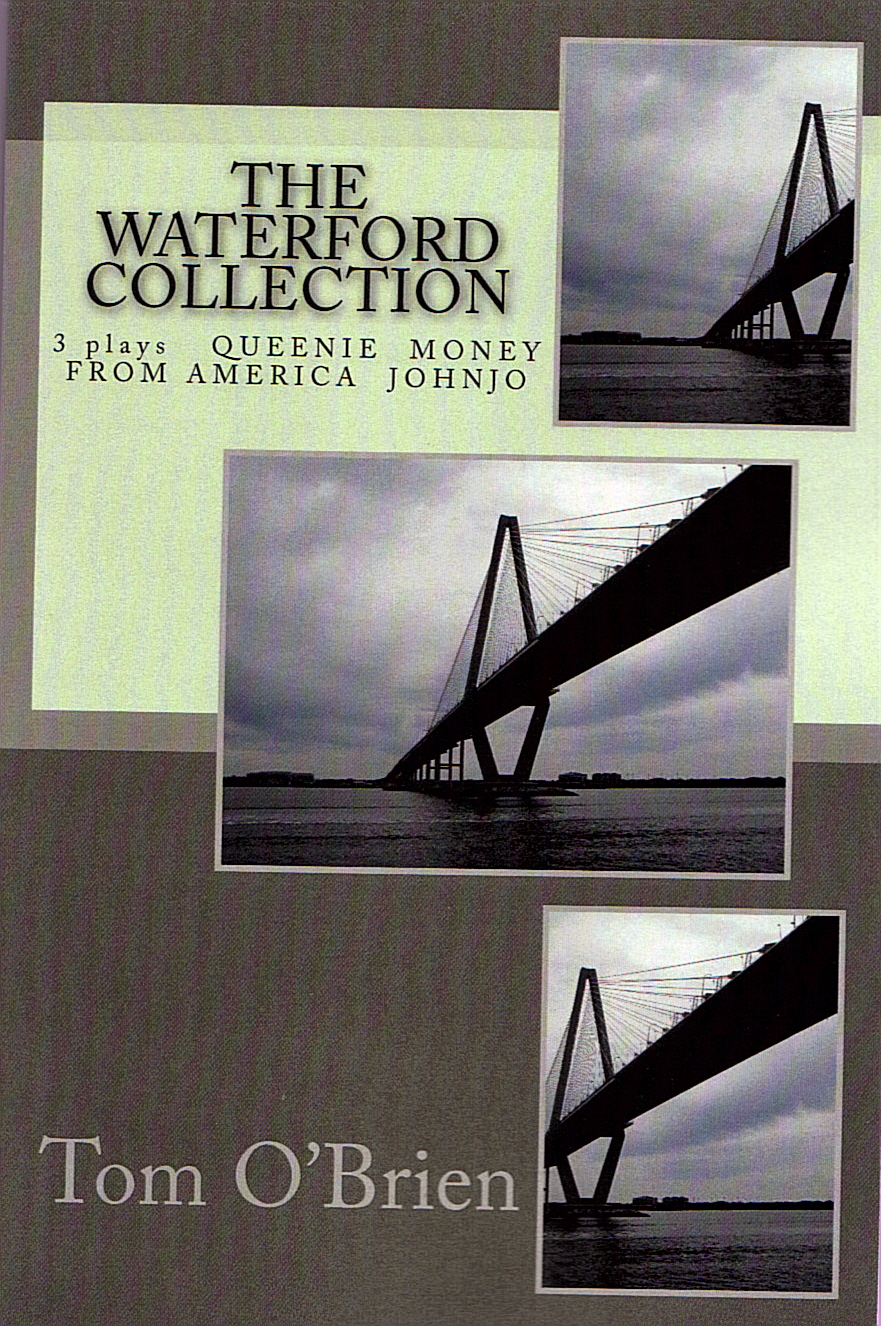
THE WATERFORD COLLECTION – 3 plays

QUEENIE…MONEY FROM AMERICA…JOHNJO

All three plays are set in rural Waterford, in the shadows of the Comeragh Mountains.

QUEENIE is a woman who has spent much of her adult life in a mental institution and has now been released into the community. She possesses second-sight, frightening psychic powere, which in the past  had seen many in the locality label her a witch.

MONEY FROM AMERICA tells the tale of two brothers and a farm. Lardy has spent all his life eking out an existence in the family hill-farm; now his brother Jack is back from America to claim his rightful inheritance, which he plans to sell.

JOHNJO is the story of a man on the run from rural Ireland and his attempt to survive amongst the chaos of war-torn England. How long can he remain in the shadows?

see my amazon page for purchasing a copy and to read an extract; http://www.amazon.co.uk/Tom-OBrien/e/B0034OIGOQ/ref=sr_tc_2_0?qid=1388083522&sr=1-2-ent
Image