
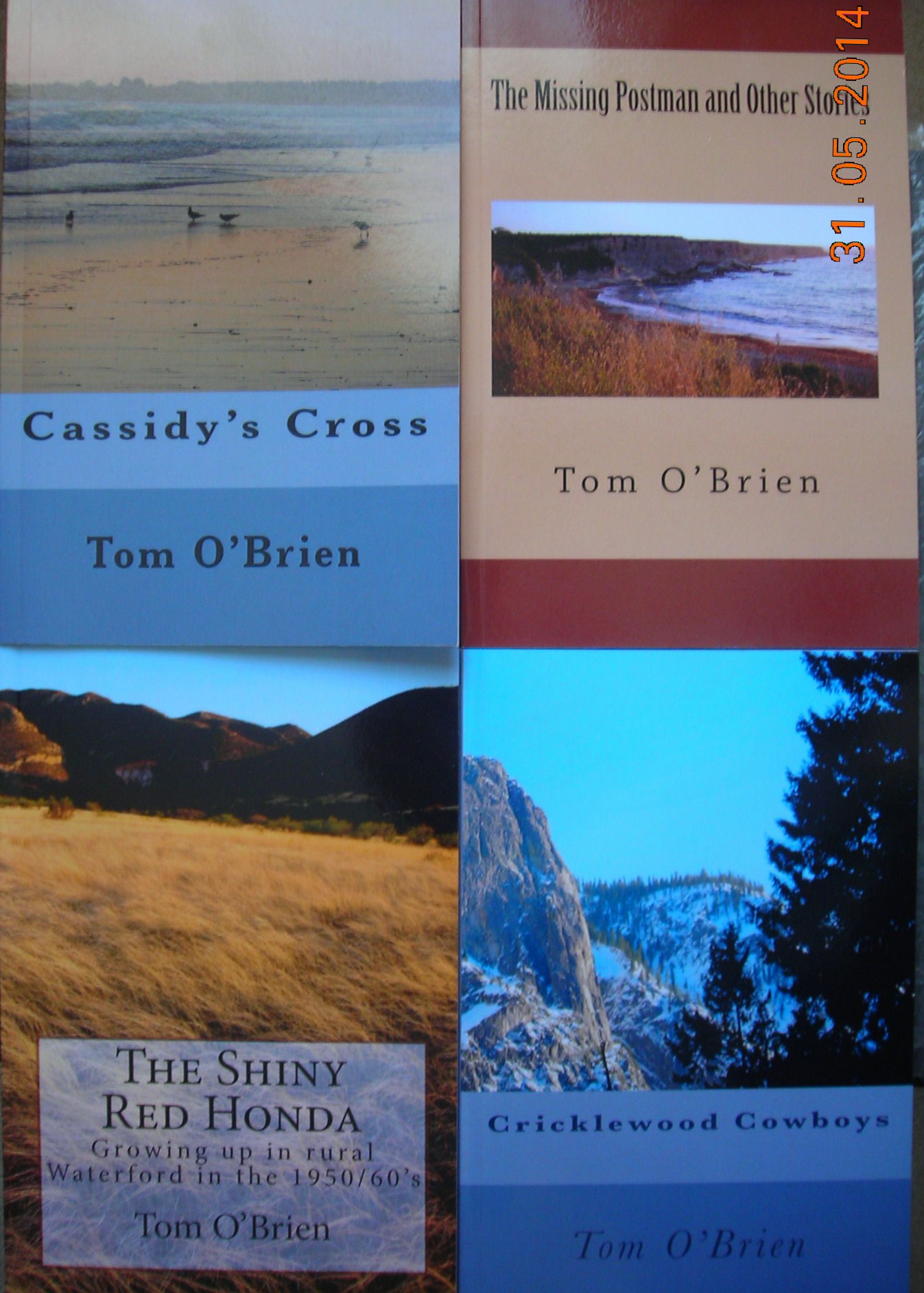
MY LATEST BOOKS…AVAILABLE @ http://www.amazon.co.uk/Tom-OBrien/e/B0034OIGOQ/ref=sr_tc_2_0?qid=1388083522&sr=1-2-ent
BOOKS
MY FIRST DRAFT IS IT

Books write authors as much as authors write books. So says Dick Francis, top-selling writer of horse-racing thrillers. The process of producing fiction is a mystery which I still do not understand. Indeed,as the years go by I understand it less and less, and I am constantly afraid that one day I will lose the knack and produce discord, like a pianist forgetting where to find middle C.
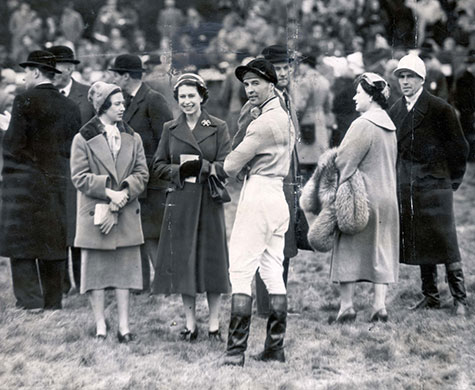
Francis, a top- class jockey before turning to writing is best remembered as the rider of the Queen Mother’s Devon Loch, who collapsed less than one hundred yards from the post in the Grand National, with the race at it’s mercy. People often ask me where I get my ideas from, and the true answer is that I really don’t know. They ask me how or why I write the way I do, and I don’t know that either. It seems to me now that one can’t choose these things and that one has very little control over them.
The author of such books as Whip Hand, For Kicks, Bonecrack,and Dead Cert – which was the first of his books to be filmed – says this about the technique of writing; I listen in a slight daze to people talking knowledgeably of ‘first drafts’ and ‘second drafts’, because when I first began to write I didn’t know such things existed. I also didn’t know that book authors commonly have ‘editors’, publishers assistants who tidy the prose and suggest changes of content. I thought that a book as first written was what got (or didn’t get) published. I still write that way. My first draft is IT. I can’t rewrite to any extent. I haven’t the mental stamina, and I feel all the time that although what I’m attempting may be different, it won’t be any better, and may well be worse because my heart isn’t in it. My publishers have mournfully bowed to this state of affairs.
He describes his method thus; When I write any one sentence, I think first of all of what I want it to say. Then I think of a way of saying it. At this point I usually write it down in pencil in an exercise book, then wait to see if a new shape of words drift into my head. Sometimes I rub bits out and change it, but once the sentence looks all right on paper I go on to the next one and repeat the process. It’s all pretty slow as sometimes one sentence can take half an hour. On the following morning I read what I’ve written and if it still looks alright I go on from there. When I have done a couple of chapters I type them out and it is this typescript that goes to the printers.
In January, he sits down to write, staring down the barrel of a deadline. “My publisher comes over in mid-May to collect the manuscript, and it’s got to be done. Each one, you think to yourself, ‘This is the last one,’ but then, by September, you’re starting again. If you’ve got money, and you’re just having fun, people think you’re a useless character.”
Dick Francis wrote more than 40 novels in this manner and they all became international best-sellers. He was one of my favourite writers and I have read most of his books over the years. He struggled with writing his books for most of his writing life, but he managed at least one a year for over forty years. That says something about his dedication to his craft. No one ever said it would be easy!
Dick Francis died in 2010, aged 89
TIME ON MY HANDS


TIME ON MY HANDS
Time, so they tell me,
Is a precious commodity;
Nowadays I own lots of it
(ever since the steelyard gates clanged shut)
I wonder how much a few weeks of it
Would fetch at Christies?
see my books on sale here; http://www.amazon.co.uk/Tom-OBrien/e/B0034OIGOQ/ref=sr_tc_2_0?qid=1388083522&sr=1-2-ent
BOOK REVIEWS ON THE STREET

Philani is a homeless man in his mid-twenties in Johannesburg, South Africa. Many people in his situation simply stand at corners begging. And that can sometimes meet basic needs…but it certainly doesn’t set a person apart or motivate people walking or driving by to donate.
But Philani does it differently. Every day he takes his ever-changing library to a different corner and sets up a sort of impromptu literary discussion group and bookshop.
For anyone interested, he will review his books and then you can buy one from him. In this way, he raises money for himself and his homeless friends as well as spreading happiness.
Philani says;
‘Reading is not harmful. There’s no such thing as harmful knowledge. This thing is only going to make you a better person.’
And if he has a kids book you’re interested in, it’s free, so that you can give it to a child.
Ride on ,Philani my friend!
See all my books for sale on amazon @ http://www.amazon.co.uk/Tom-OBrien/e/B0034OIGOQ/ref=sr_tc_2_0?qid=1388083522&sr=1-2-ent
JACK REACHER IS NUMBER ONE!
I love serial character in books; you know, Inspector Wexford, Rebus, George Smiley, Kay Scarpetta etc
My favourite though has to be JACK REACHER, the eponymous hero – or is it anti-hero – of the books written by LEE CHILD,
Jack is a drifter, a loner, travelling across the USA, finding trouble without looking for it wherever he goes. I don’t know how many books there are to date – probably around 20 – but I have read most of them; ECHO BURNING, PERSUADER, THE ENEMY, ONE SHOT, GONE TOMORROW, 61 HOURS to name a few, and I am always amazed at how gripping and addictive they are.
A former Major in the United States Army Military Police Corps, JACK quit at age 36, and roams the United States taking odd jobs and investigating suspicious and frequently dangerous situations. The paradox of JACK is that he is both a big bear of a fighter , and a thinker, whose mission appears to be to right wrongs and defend the weak.
JACK always uses an alias when checking into a hotel. In earlier stories, this was usually the name of a lesser known ex-president. In later stories, he more often used baseball players’ names.
Since leaving the Army, JACK has been a drifter. He wanders throughout the US because he was accustomed to being told where to go, when to go and what to do for every day of his life from military childhood to military adulthood. He also felt he never got to know his own country, having spent much of his youth living overseas on military bases and at West Point. He usually travels by hitchiking or bus. As a drifter, the only possessions he carries are money, a foldable toothbrush and, after 9/11, an expired passport and an ATM debit card
JACK has the uncanny ability to know what time it is, at any time of the day, without referring to a clock. He often uses his internal clock as an alarm, enabling him to wake up at any time he chooses. He is a skilled marksman, and is highly skilled at fighting, enhanced by in-depth technical and military knowledge.
All in all JACK REACHER is the perfect all-round hero
WRITERS AND THE CHELSEA HOTEL
 Dylan Thomas
Bob Dylan, Sid and Nancy, Leonard Cohen, Andy Warhol, Janis Joplin were among a long list of artists and musician who stayed at the Chelsea Hotel NY at one time, adding to its reputation as a decidedly bohemian enclave. Musicians and artists dominated the headlines through the 13 decades since the Chelsea’s construction in 1884. But the grand hotel-for-the-arts on New York’s West 23rd Street has inspired literary works as well, and often it was the writers who shaped the narratives on which artists working in other disciplines based their work.
Below are a few of the writers who stayed there:
DYLAN THOMAS “Excuse me,” Dylan Thomas apologized, following a terrible fit of coughing and retching into his rusty Chelsea hotel sink. He suffered from a medical condition, he explained. “I think it’s called cirrhosis of the liver.” The popular Welsh poet drank too heavily to produce much of literary merit during his numerous stays at the Chelsea Hotel.
BRENDAN BEHAN Alcoholism had not only gotten the Irish playwright and novelist Brendan Behan kicked out of Algonquin and Bristol Hotels by 1963, it had also destroyed his ability to hold a pen. At the Chelsea, though, the choreographer Katherine Dunham and her dancers were able to nurse him back to health. At the Chelsea, the writer dictated Brendan Behan’s New York, a lyrical tribute to his favorite city, into a tape recorder when not singing Israeli songs with the poet Allen Ginsberg, dancing in the halls with Communist leader Elizabeth Gurley Flynn, befriending Eugene O’Neill’s ex-wife Agnes Boulton, or carrying on affairs with male and female lovers while managing visits from his long-suffering wife as well. Brendan Behan
JACK KEROUAC It was one of those nights of “metropolitan excitements,” Kerouac wrote of the night in 1953 when he and William Burroughs encountered Gore Vidal at the San Remo bar. Already drunk with joy over the publication of Burroughs’s Junkie, the two writers eagerly incorporated Vidal into the night’s revelries. But as the drinking progressed, Burroughs peeled off–leaving Kerouac and his handsome fellow writer to muddle-headedly resolve to pay tribute to their predecessors Thomas Wolfe and Dylan Thomas by consummating their friendship at the Chelsea Hotel.
 Jack Kerouac
THOMAS WOLFE “The desire for it All comes from an evil gluttony in me,” confessed Thomas Wolfe, who had moved into the Chelsea on Edgar Lee Masters’s recommendation and whose rumbling, Southern-accented voice permeated the corridors as he paced the floor each night dictating scenes for a novel. To Masters, who invited Wolfe down for a nightcap occasionally, the writer seemed a force of nature, loudly decrying the changes he saw in his countrymen in the wake of the Depression. America had lost its way, Wolfe insisted.
ARTHUR MILLAR Arthur Miller came to the Chelsea in 1962 to escape his disastrous marriage to Marilyn Monroe, but once he started writing, he found he couldn’t duck his history quite so easily. His new play, After the Fall, was meant to explore, in this post-Nazi era, the individual’s responsibility for the fate of a fellow human, but it soon became clear that Miller was also exploring his role in Monroe’s self-destruction. Even after the announcement of Monroe’s suicide, Miller denied the true identity of his play’s female protagonist.
 Arthur Millar
ARTHUR C CLARKE In 1965, long-time Chelsea veteran Arthur C. Clarke checked in for a stint at the hotel, pounding out 2,000 words a day on a novel-length accompaniment to 2001: A Space Odyssey, his collaboration with filmmaker Stanley Kubrick. Kubrick had tried to work with Clarke at his own office in Manhattan, but after one day’s work the writer returned to the Chelsea to draw on conversations with William Burroughs, Allen Ginsberg, Arthur Miller and others for inspiration for his work.
WILLIAM BOROUGHS William Burroughs and his close friend, the Canadian artist Brion Gysin, arrived at the Chelsea Hotel in 1965 to market a new invention, the Dream Machine, a contraption consisting of a spinning paper cylinder with slitted sides and a light bulb inside whose purpose was to create a psychedelic experience for the viewer without the use of drugs. When it failed to make them rich, the pair turned to a new collaboration equally in tune with the Chelsea Hotel zeitgeist: The Third Mind, a exploration of the synergetic power of creative collaboration.

