LIFE AINT WOT IT USED TO BE (continued)

Scene 5

LIONEL: (in spotlight)                                                                                               My mother was forty-nine when she had me. Or so she said! Or was it forty-one? Anyway, by that time she had very little strength left to give me the affection and love I craved.  I remember sitting by the piano as a boy, playing tunes to make her smile. But she was too tired to even clap. Not only was I deprived of love, I had no money either, so you can imagine when I hit it really big with Oliver, the novelty of being wealthy was more than I could cope with. Trouble is money doesn’t automatically bring love, does it? And I needed love. So I thought I could buy it.

John Gorman appears in another spot. They both sing a verse of ‘Can’t Buy Me Love.

BOTH:                                                                                                                           Can’t buy me love, love
Can’t buy me love

I’ll buy you a diamond ring my friend
If it makes you feel alright
I’ll get you anything my friend
If it makes you feel alright
‘Cause I don’t care too much for money
For money can’t buy me love

LIONEL:

I wish I had written that. Not bloody Lennon.

JOHN:

Don’t forget McCartney.

LIONEL:

They wrote that in Alma’s flat you know. In fact I think she helped.( Pause}                   

Money can’t buy me love.

JOHN:

You bought plenty of other stuff though. You’ve always been chasing something, Lionel. Love, fame, money… but you’ve already got more than most people ever dream of. You had four fancy cars at one stage. And a chauffeur-driven limo. Not to mention that palace in Chelsea.

LIONEL:

Aye. The Fun Palace. Money was no object and I had this desperate need to be loved. And I used to think that giving someone an expensive present was a foolproof way of buying their affection. Today, of course, by some irony the situation is reversed. I’m so broke it is they who are giving me the gifts. The worst thing about being bankrupt John, Is having no…money! It really pisses me off. In fact, I was so pissed off this morning that I wrote this new song – Bankruptcy Blues.

He hands john a copy of the lyrics and they sing it, with Lionel on piano

BOTH:

Bankruptcy Blues”
(In the style of Lionel Blair)

(Verse 1)
Oh, the bills came knocking, and the debts piled high,
The bank said, “Sorry, love, but now it’s goodbye!”
I once had a fortune, now I’ve got naught but air,
But I’ll tap-dance through the chaos, ‘cause I just don’t care!

(Chorus)
It’s the Bankruptcy Blues, oh, what a lark!
I’m singing in the dark, though the future’s not so stark.
With a wink and a grin, I’ll let the troubles slide,
For every cloud’s got a silver lining inside!

(Verse 2)
The creditors are calling, but I’m out of sight,
I’m waltzing through the ruins, keeping spirits light.
They took my car, my house, and my fancy yacht,
But they’ll never take my joy—oh no, they cannot!

(Chorus)
It’s the Bankruptcy Blues, oh, what a show!
I’m down, but not out, and the world will know.
With a twirl and a spin, I’ll rise from the ash,
For life’s a grand performance, and I’m here to sashay!

(Bridge)
So here’s to the dreamers who’ve lost it all,
Who’ve stumbled and fallen but still stand tall.
Bankruptcy’s a chapter, not the end of the book,
With a song in my heart and a hopeful look!

(Final Chorus)
It’s the Bankruptcy Blues, oh, what a ride!
I’ll take it in my stride, with my pride as my guide.
With a laugh and a song, I’ll turn the tide,
For life’s a stage, and I’m still on the bright side!

(Outro)
So raise a glass to the ups and the downs,
To the smiles and the frowns, and the spins and the rounds.
Bankruptcy’s a dance, and I’m leading the way,
With a twinkle in my eye, I’ll steal the day!

JOHN:

There’s still life in the old dog eh! (pause) When you mentioned the Fun Palace back there, something that’s been bothering me for ages came to mind. Where did that name come from?

LIONEL thinks for a moment

LIONEL:                                                                                                                       The Fun Palace? It was something that Joan – Joan Littlewood – wanted to set up. An avant-garde theatre scene of the 1960s. A sort a visionary project conceived by Joan  and architect Cedric Price, designed to be a dynamic, interactive cultural space that blurred the lines between art, technology, and community.                               Although it was never fully realized, it remains a symbol of radical creativity and innovation. It was never built due mainly to financial and logistical challenges.   Joan’s Fun Palace was supposed to be this grand, revolutionary thing. Mine? Just a fancy house with too many rooms and not enough love.                                     (laughs) I just nicked the name for my place!

Lionel visualises a conversation between himself and Joan

JOAN:
(gesturing wildly)
Imagine it, Lionel—a place where art, science, and community come together. No  

LIONEL:
(skeptical)
Sounds like a pipe dream, Joan. How are you going to pull it off?

JOAN:
(grinning)
With a little help from my friends. You in?

LIONEL:
(laughing)

If you build it Joan, they will come! (to the audience)
Life’s a stage, and I’m still dancing. Even if the music’s stopped.

End of scene

Scene 6
LIONEL:(to the audience)                                                                                           When I was a young kid in the East End, there was a sweet shop opposite our house where you could get a chocolate bar with a toffee in it for a penny. It was called ‘Oliver’, and the wrapper around it had a picture of a lad asking for more. I never forgot that image. And then I saw that film by David Leon…

John Gorman appears

JOHN:                                                                                                                       Yeah. Oliver. I was there too, remember? We had bunked off from our National Service to see it. I remember you sayin’ you had never even read Oliver Twist back then.

LIONEL:                                                                                                                           I still haven’t got round to it.

JOHN:                                                                                                                         How can you write a play about a book you haven’t even read?


LIONEL:                                                                                                                      Easy peasy. I was reading an article one night recently about how Dickens had gone about writing it, and it hit me—this story was meant to be sung. The characters, the drama, the heartbreak… it was all there, just waiting for a tune

He plays and sings at the Piano. Alma Cogan comes in during this and joins in

LIONEL:

I’ve already written a few (sings’ Food, Glorious, Food’) 

 Is it worth the waiting for?
If we live ’til eighty four
All we ever get is gru…el!
Ev’ry day we say our prayer —
Will they change the bill of fare?
Still we get the same old gru…el!
There is not a cust, not a crumb can we find,
Can we beg, can we borrow, or cadge,
But there’s nothing to stop us from getting a thrill
When we all close our eyes and imag…ine

Food, glorious food!
Hot sausage and mustard!
While we’re in the mood —
Cold jelly and custard!
Pease pudding and saveloys!
What next is the question?
Rich gentlemen have it, boys —
In-di-gestion!

Food, glorious food!
We’re anxious to try it.
Three banquets a day —
Our favourite diet!

Just picture a great big steak —
Fried, roasted or stewed.
Oh, food,
Wonderful food,
Marvellous food,
Glorous food.

source: https://www.lyricsondemand.com/soundtracks/o/oliverlyrics/foodgloriousfoodlyrics.html                                                                                                                                                       

LIONEL:
There’s a lot more, but It goes something like that.

ALMA:
A musical about a workhouse boy? Lionel, are you sure this will work?
LIONEL:
It’s not just a workhouse boy. It’s a story about survival, hope, and the power of love. And I feel it’s going to be a hit. (Pauses) What if they hate it though? What if I’ve made a terrible mistake?
JOHN:

Relax, Lionel. You’re creating something extraordinary. Just wait and see.

LIONEL:

Alma, I was thinking of asking you to maybe play the part of Nancy. You know who Nancy was?

ALMA:

(laughing) Of course I do. Not like you, I read the book. She was Bill Sykes girlfriend

LIONEL:

Yes, she was. Nancy is one of the most complex and compelling characters in Oliver!, She plays a crucial role in the story, embodying themes of loyalty, love, and sacrifice. Here’s a bit of a scene I am working on with Nancy and  Oliver. Let’s read it together.

He hands her a sheet of the script.

LIONEL:

I’ll be Oliver. (then he looks at John and hands him a page) You can be Bill

LIONEL:(reads) A dimly lit room in Fagin’s hideout. Nancy is sitting alone, holding a shawl. Oliver enters, looking scared.

OLIVER:
(softly)
Nancy?

NANCY:
(smiling)
Oliver. Come here, love.

LIONEL reads. ‘Oliver sits beside her, and she wraps the shawl around him’.

NANCY:
You’re safe now, Oliver. I won’t let anything happen to you.

OLIVER:
(tearfully)
But what about Bill? He’ll hurt you if he finds out.

NANCY:
(softly)
I know, love. But some things are worth the risk.

(She begins to sing As Long As He Needs Me, her voice filled with emotion.

NANCY:
(singing)
As long as he needs me…
Oh, yes, he does need me…
In spite of what you see…
…I’m sure that he needs me.

Who else would love him still
When they’ve been used so ill?
He knows I always will…
As long as he needs me.

I miss him so much when he is gone,
But when he’s near me
I don’t let on.

As she finishes, Bill Sikes enters, his face dark with anger.

BILL:
(grabbing Nancy)
What do you think you’re doing, Nancy?

NANCY:
(defiantly)
I’m doing what’s right, Bill. For once in my life, I’m doing what’s right.

BILL:
(angrily)
You’ll regret this, Nancy.

He drags her away as Oliver watches, helpless. The lights dim as the scene fades.

LIONEL:

That’s far as I’ve got. What do you think? Are you up for it?

ALMA:

I don’t know. You know how I hate being tied down to anything – or any place – for too long.  I’m a singer Lionel. I like variety. A new place every week. A long run is just not my scene. (pause} Look at Fings Aint Wot they Used To Be. It’s already been running over six months in the West End. And they say it’s sold out for the rest of the year. And it ran for over a year at Stratford East before that.

LIONEL:

And you could have been part of it Alma. Instead, Barbara Windsor is getting all the attention.

ALMA:

Like I said, I don’t think it’s me.
LIONEL:

You might come to regret it. I just have a feeling that this is the big one.

ALMA:

(smiles and sings)

Que Sera Sera, whatever will be will be

The future’s not ours to see, Que Sera Que Sera.

End of scene

KATHY KIRBY: ICON

https://youtu.be/8sV_c0Pbm50

Discovered and mentored by the great band leader Bert Ambrose, Kathy Kirby was groomed in the image of his ideal woman – a kind of late 1950s hybrid of Marilyn Monroe and Diana Dors, with crisply styled peroxide hair and startlingly glossy red lips. Ambrose’s concept was dated even by the time Kirby became a major television star on the strength of her early 1960s appearances inStars and Garters. But somehow – largely thanks to a winning and cheerful personality that knew instinctively how to reach a television audience beyond the camera and, crucially, a voice of spectacular power and emotional force, which commanded attention whatever she was singing – she transcended the stylistic straightjacket he imposed on her.

As so often in the annals of show business, Kathy Kirby’s life eventually came to mirror the more dramatic lyrics of some of her songs. This, combined with the unique qualities of her voice, dusted her with an almost mythical fascination, long after her active career had waned.

Ambrose had given Kirby her first break as a teenager, employing her on a short contract as a vocalist for his dance band after she had persuaded him to let her sing for him at the Palais de Danse in Ilford when she was just 16, in 1954. She spent the next few years paying her dues on the club circuit, singing with Ambrose on and off, and gaining valuable show-business experience. But it was not until he became her manager and took control of her recording and television career that things really took off, culminating in hit singles and albums for Decca, and some hugely popular television series. Their relationship soon developed privately and they would be together until his death in 1971, an arrangement that would have disastrous consequences for Kirby.

A new play, KATHY KIRBY: ICON, running at THE WHITE BEAR theatre, Kennington, sets the record straight about Kathy’s life,both in and out of the glare of publicity.

Listen to an interview by the actress who plays kathy on BBC Radio London. The interview is apprx 2hrs 13mins into the programme

http://www.bbc.co.uk/programmes/p03412rf

28-09-2015 19;20;25

KATHY KIRBY THE MUSICAL

KATHY KIRBY – ICON @ The White Bear Theatre, Kennington, London… 20th Oct – 8th Nov.

BE THERE!

https://www.facebook.com/KathyKirbyIcon?notif_t=page_invite_accepted

28-09-2015 19;20;25BookCoverImage

book available in paperback on Amazon.

JOHNJO REVIEW

REVIEW OF MY PLAY ‘JOHNJO’, performed recently CENTRAL ARTS, JORDAN’S LANE WATERFORD

03-08-2015 14;05;03 

A View from the Green Room.

Pat McEvoy.

Arts Correspondent..WATERFORD NEWS & STAR

DISTURBING ‘JOHNJO’ AT CENTRAL ARTS.

Johnjo McGrath enters singing ballad of The Rocks of Bawn and you just know that there is a story to be told. It was a favourite of his father who barely knew the words, or the notes, if the truth be told. A small landholder of twenty acres on the Comeraghs of which only five were arable, he carried ancient grudges around like boulders. Clearing land that was full of furze, rock and limestone, he cursed his circumstances and drank a lot of whiskey to dull the pain.

He references Crotty the highwayman and understands the shared experience of disenfranchisement. He curses the Curraghmores and their acres of lawns that would have fed the bellies of half-fed cattle. Not that he had too many of those. It’s the sense of privilege and entitlement about the Curraghmores that gets to him. It eats away at him and he sees no shame in stealing the odd sheep of theirs and selling it on to slaughter. He feels dispossessed and evicted from his land and blames it on the greed of the Anglo-Irish who never had enough.

A selfish father with a grievance, he drank all he had and when he drowned himself, Johnjo had to sell the bullock to meet the funeral expenses.   With only £2-10 the mother mortgages the land and moves into the town. A knife-incident leaving a man badly wounded, forces him to flee and it’s the boat in wartime for Johnjo.

Grim times. Working on the lump, with an array of identities to avoid detection, it’s a grim and lonely existence. Kavanagh’s lines of the women who love only young men ring in the ear of the aging man who moves between damp and over-crowded doss-houses while building the motorways. The gangers are always the same. Elephant John is a tough task-master who can really dish it out. And it’s always Paddy. Never Johnjo. Still no matter when you’re on the lump. The names tumble our like tourist dishcloths…Tom Dooley…Roy Rogers…Gene Aughtry…Donald F****in’ Duck.

But a life without children. And a wife. Before he knows it, he’s fifty. It’s been an empty existence claims Johnjo but odd facts begin to pop out from the coiled spring of resentment. Sexual ambiguities surface. He prefers the company of men. Their smell. Their friendship. A band of building brothers. It’s a world of sexual compromise and secrets hidden from even himself.

He hates Bannagher, the jumped-up Irish boss who also owns the pub in Cricklewood where the wages are paid. He only pays by cheque and charges 5% on cashing cheques for subbies who he knows can never have a bank account. When a trench collapses killing Johnjo’s only friendKennedy because of poor scaffolding, Johnjo settles accounts with Bannagher in the old time-honoured way of blood-payment.

Eamon Culloty is excellent as the spiteful-regretful-sexually-ambivalent Johnjo. In what was once a best suit, he brings the whole range of despised Paddy to the stage. It’s a performance that’s always highly charged and directed with great sympathy by James Power. The emptiness of a wasted life is what remains with you after the performance. There’s nothing simple about a performance that seems to constantly search for answers and, perhaps, other ways to have gone about his business. His father’s son, he doesn’t get his sense of dispossession from the ground. He doesn’t blame the father and scoffs at Larkin’s line: they f**k you up, your mum and dad’. ‘No’ Johnjo declares ‘I f**ked them up’.

Tom O’Brien’s writing always seems to drive Johnjo on to a conclusion based on the navvies’ experience.  His wisdom is bought at a price that no one  should really have to pay. O’Brien lays Paddy’s experiences in post-war Britain bare…lodgings in damp rooms crammed with other Paddies trying to get by. Weekends trying to dull the pain of existence through drink and then looking for a sub on Monday to get through the week.

Great to see Waterford playwright Tom O’Brien’s work on a Waterford stage. Let’s see more of it.

KATHY KIRBY – ICON

BookCoverImage

now available as a paperback on Amazon

KATHY KIRBY ALWAYS WANTED STARDOM, AND FOUND IT AT THE AGE OF 16 UNDER THE GUIDANCE OF RENOWNED BANDLEADER BERT AMBROSE. BEFORE TOO LONG SHE WAS THE MAIN SINGER IN HIS BAND, AND NOT LONG AFTERWARDS HIS MISTRESS – DESPITE THE FORTY-YEAR AGE GAP.      SHE HAD EVERYTHING; A REMARKABLE VOICE, STUNNING LOOKS, AND WAS SOON A MAJOR TV AND RECORDING STAR. ‘BRITAIN’S ANSWER TO MARILYN MONROE’, THE NEWSPAPER SCREAMED CONSTANTLY.                       YET BY HER LATE THIRTIES SHE WAS A FALLEN STAR. SHE STOPPED PERFORMING COMPLETELY, BECAME A RECLUSE, AND EVENTUALLY DIED IN POVERTY. SO WHAT WENT WRONG FOR KATHY KIRBY? THIS PLAY ANSWERS THAT QUESTION.

Playing at the WHITE BEAR THEATRE  138 Kennington Park Rd, London SE11 4DJ, this coming October. Watch this space for further details.

MY FATHER – a poem by John Osborne

John Osborne poet

John Osborne  was an English playwright, screenwriter, actor and critic of the Establishment. The success of his 1956 play Look Back in Anger transformed English theatre.

In a productive life of more than 40 years, Osborne explored many themes and genres, writing for stage, film and TV. His personal life was extravagant and iconoclastic. He was notorious for the ornate violence of his language, not only on behalf of the political causes he supported but also against his own family, including his wives and children.

Osborne was one of the first writers to address Britain’s purpose in the post-imperial age. He was the first to question the point of the monarchy on a prominent public stage. During his peak (1956–1966), he helped make contempt an acceptable and now even cliched onstage emotion, argued for the cleansing wisdom of bad behaviour and bad taste, and combined unsparing truthfulness with devastating wit.

MY FATHER

My father lived a simple life
But he was a man apart
With gentle ways and humble mind
And an understanding heart

He loved and cared for people
Helping those in need.
He strove to make folk happy
For kindness was his creed.

He never aimed for dizzy heights
Of luxury or fame
But where he walked and where he talked
With love he carved his name.

He was like a rock to lean upon
Each problem he would share.
He found his strength in his belief
And in kneeling down in prayer.

He loved his home and lived his life
With fullness to the end
He taught me much I owe him much
A father and a friend.

Death was peace and joy to him
It was no fearful thing,
His faith was simple and sincere
And God alone his king.

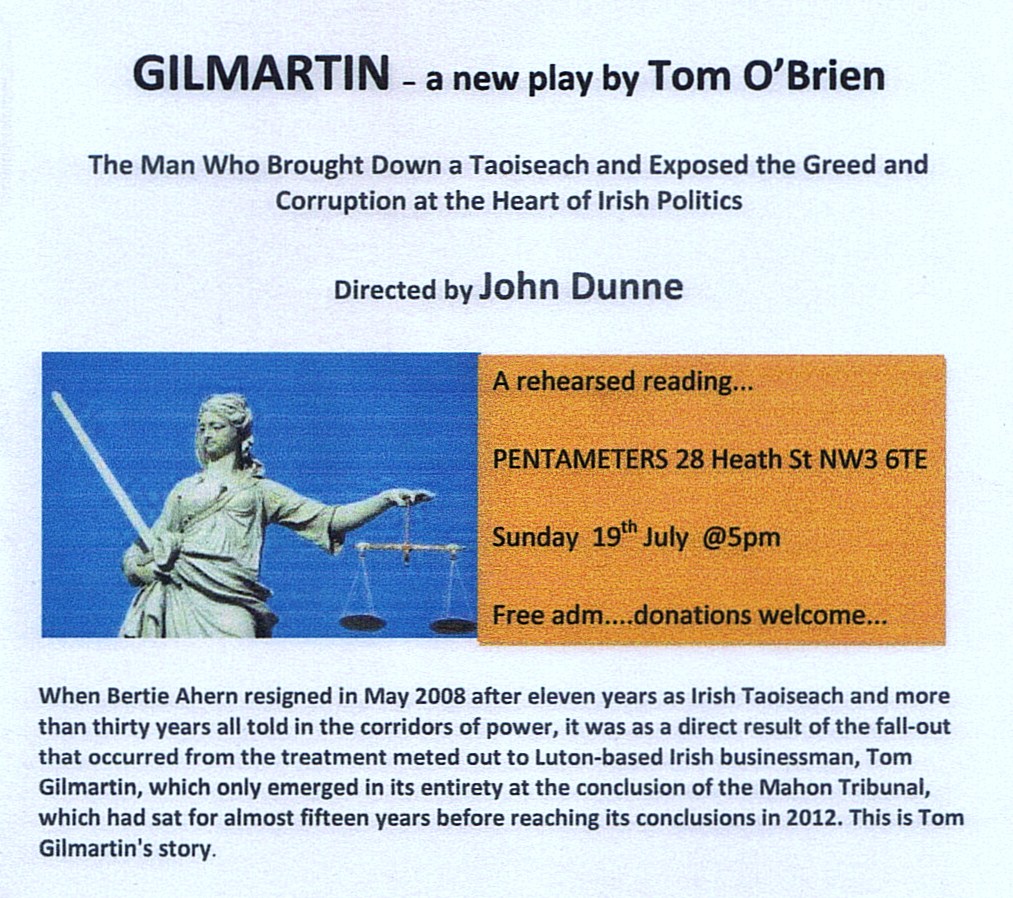
GILMARTIN – a new play

My report on Sunday’s reading of Gilmartin at Pentameters:IMG_7398IMG_7395
The first thing to say is that there were quite a few surprises. The first was that we nearly had a full house for the occasion! It’s usually unheard of to get more than a handful to come to readings. The second was that the cast got a standing ovation at the end. The third was that a life-long friend of Gilmartin’s fetched up from Luton, and was so moved by the occasion that he almost broke down in tears at the q/a session afterwards. He did manage to issue an invitation to us to repeat the exercise in Luton, where he said we would have no problem getting a couple of hundred to come.  But the biggest surprise of all was that Tom’s  son and daughter turned up. They were very complimentary about the whole thing, particularly Tom Jr, who felt that we had got the essence of the story, and more importantly, the essence of his father. Phew…thank God for that!
As for the play itself, I thought it worked very well as a piece of theatre – much better than I expected. I wasn’t sure if the audience would get the story, being quite mixed, and story being so Irish, but they got it in spades! It seems to be a universal tale; corruption at high level, and contemptible treatment of the ordinary man/woman. The script still needs a little tweaking here and there, but not much, and I did get some useful insights to the man from Tom Jr – which I can add to the mix.
Where do we got from here? Not sure yet; we may go for a run at Pentameters later in the year or early next year, and we may well take up the invitation to do the gig in Luton, but there were also serious suggestions that we should do it in Dublin. The topic is still very hot in Ireland; and all the main protagonists are still walking around free as birds over there. They should be prosecuted but I don’t think the relevant authorities have any appetite for doing it. Apparently Bertie Ahern was on Irish radio yesterday being questioned about the bank scandal so none of it has gone away.
I think it could be a ‘big’ play if we could get the right backing, and my feeling is that a tour of Ireland, starting in Dublin, could be the way to go. It’s early days yet, so I think we will await developments for now.

ROLL ON TOMORROW!

13-07-2015 22;48;06

come along if you can – it’s FREE!

HOW TIME FLIES

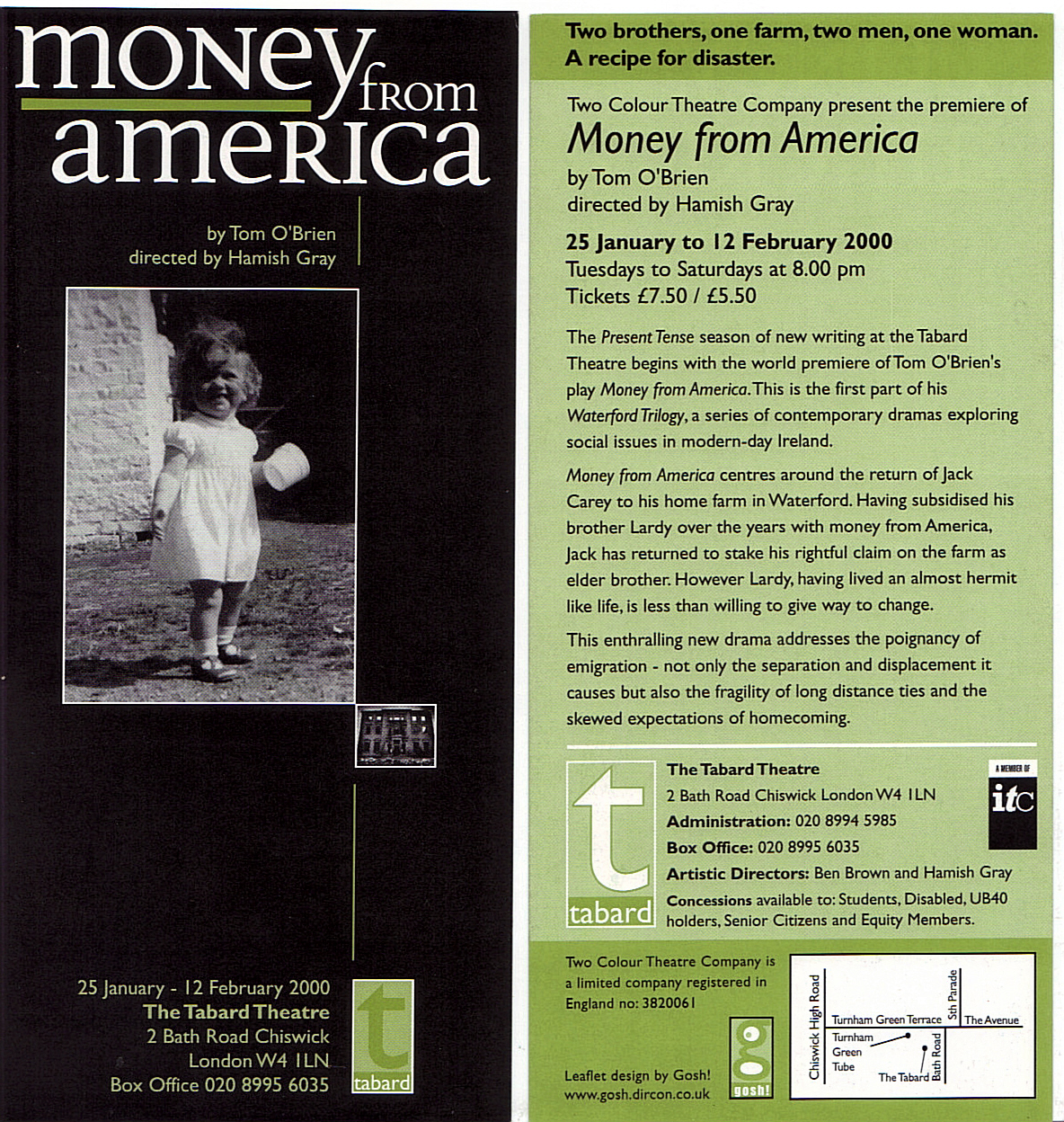
This was the first performance of my first play. How time flies!

HOW TIME FLIES!

HOW TIME FLIES!

GILMARTIN

08-07-2015 11;15;21

DON’T MISS!

FREE ADMISSION

PENTAMETERS THEATRE, SUN 19th JULY @5pm

(50 yards from Hampstead Tube Station)