THE BLUE LAGOONS OF MAYO

imagesCA1C7P4PimagesCAH8N1X0

THE BLUE LAGOONS OF MAYO
Like oceans behind my eyes
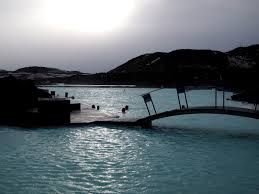
The blue lagoons of Mayo glittered in the mist
‘Blue lagoons of Mayo? – Christ that’s rich’, remarked O’Hare
‘Unless the bogs have changed their colour since I resided there’
‘I remember ploughing through the Mayo wind and rain
Endlessly
And ne’er a pinch of blue did I ever snare
Do you remember The Playboy of the Western World?
Christy Mahon – now he could tell you a thing or three
About bogs, blue or otherwise
And windswept, storm-ridden, mackerel skies
He thought he killed his father
But no such luck
Like a faithful old dog
He followed Christy fretfully through mist and fog
Howlng into the wind
You never killed me with your loy
That time back there in the bog, boy’
‘.

http://www.amazon.co.uk/Tom-OBrien/e/B0034OIGOQ/ref=sr_tc_2_0?qid=1388083522&sr=1-2-ent

PAPA’S TRIBE

13_04_2009_0103455001239641944_arthur-elgortimg_0827-0

PAPA’S TRIBE
The wives and mistresses
All mealy grins and doughy skins
With their ever-wet holes
And their second-hand sins
Watching as the mirror butterflies their faces
Twinned with depthless images of themselves
Wronged women staring back in anguish
Each flopped vacuously on vacant shelves
Leftovers or left behinds
None are sure of which is which
All of them are certain of one thing though;
It’s one of the others
That is the biggest bitch.

http://www.amazon.co.uk/Tom-OBrien/e/B0034OIGOQ/ref=sr_tc_2_0?qid=1388083522&sr=1-2-ent

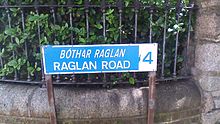
ON RAGLAN ROAD

WIN_20140609_141231Patrick_Kavanagh_by_Patrick_Swift

Patrick Kavanagh was born in the village of Enniskeen, Co Monaghan on 21st October 1904. The son of a shoemaker and small farmer, he moved to Dublin at the age of 35, where he lived in poverty for most of his life. He survived on handouts, bits of journalism, and being supported for a time by his younger brother, Peter, who was teaching in the city. On Raglan Road is a poem about his doomed love-affair with Hilda Moriarty. Hilda was middle-class, the daughter of a wealthy Kerry doctor; he was a penniless poet, uncouth and unwashed, of small-farmer stock – indeed, a small farmer himself, who had forsaken the plough for the pen. His finest poem ‘The Great Hunger’ was so controversial that he was threatened with prosecution under the obscene publications act. Always a controversial figure, he was hated as much as loved in Dublin, and his long-running feud with Brendan Behan is well-chronicled. To Behan he was’ the fucker from Mucker’, while Patrick maintained that the only journey Brendan ever made was ‘from being a national phony to becoming an international one’.

ON RAGLAN ROAD

On Raglan Road on an autumn day I met her first and knew
That her dark hair would weave a snare that I might one day rue;
I saw the danger, yet I walked along the enchanted way,
And I said, let grief be a fallen leaf at the dawning of the day.

On Grafton Street in November we tripped lightly along the ledge
Of the deep ravine where can be seen the worth of passion’s pledge,
The Queen of Hearts still making tarts and I not making hay –
O I loved too much and by such and such is happiness thrown away.

I gave her gifts of the mind I gave her the secret sign that’s known
To the artists who have known the true gods of sound and stone
And word and tint. I did not stint for I gave her poems to say.
With her own name there and her own dark hair like clouds over fields of May

On a quiet street where old ghosts meet I see her walking now
Away from me so hurriedly my reason must allow
That I had wooed not as I should a creature made of clay –
When the angel woos the clay he’d lose his wings at the dawn of day.

ALL MY BOOKS

51dZvCktoZL17-06-2014 19;58;5516-03-2014 11;15;14

MY BOOKS PAGE ON FACEBOOK;

https://www.facebook.com/#!/pages/My-books/822507557782345

ALL MY BOOKS ARE AVAILABLE ON AMAZON;

http://www.amazon.co.uk/Tom-OBrien/e/B0034OIGOQ/ref=sr_tc_2_0?qid=1388083522&sr=1-2-ent

THE WATERFORD COLLECTION REVIEW

C:\Users\User\Desktop\15-06-2014 18;56;39.jpg


THE MUNSTER EXPRESS 24th June 2014


ARTS & THEATRE COLUMN


COLLECTION OF PLAYS REVIEW Tom O’Brien


The Co Waterford-born playwright and novelist, Tom O’Brien has just had another successful three week run with another new play, No Blacks, No Dogs, No Poles, in London’s Pentameters Theatre. The play despite its provocative title with echoes of a time when ‘No Irish’ might have given it a London context, but this play is set in an Irish town. I was not able to attend its premiere, but Alan Cliff the (up to last year) Waterford-based playwright went along and gave me his considered opinion. Alan is studying theatre in Manchester.

He described the play as complex in structure with at least four aspects overlapping; the return of a son-in-law, who has married an Aboriginal Australian and this brings out themes of racism and bigotry; a revelation of another characters bi-sexuality; the introduction of drugs into the family via a hostage situation; the revelation of an illicit family member’s affair. The London reviews suggested some confusion with themes of racism, immigration, identity and a longing for the past, spiced with sexual repression.

To coincide with this production O’Brien has brought out a collection of three plays, all with Waterford connections, with the title, The Waterford Collection, and its three plays show the detail and proven ability of the author to forge a career for himself. I still find it hard to understand why no Irish or indeed no Waterford theatre group have as yet staged one of his plays. Stagemad Theatre Company were to do so, but it never came to rehearsal stage.

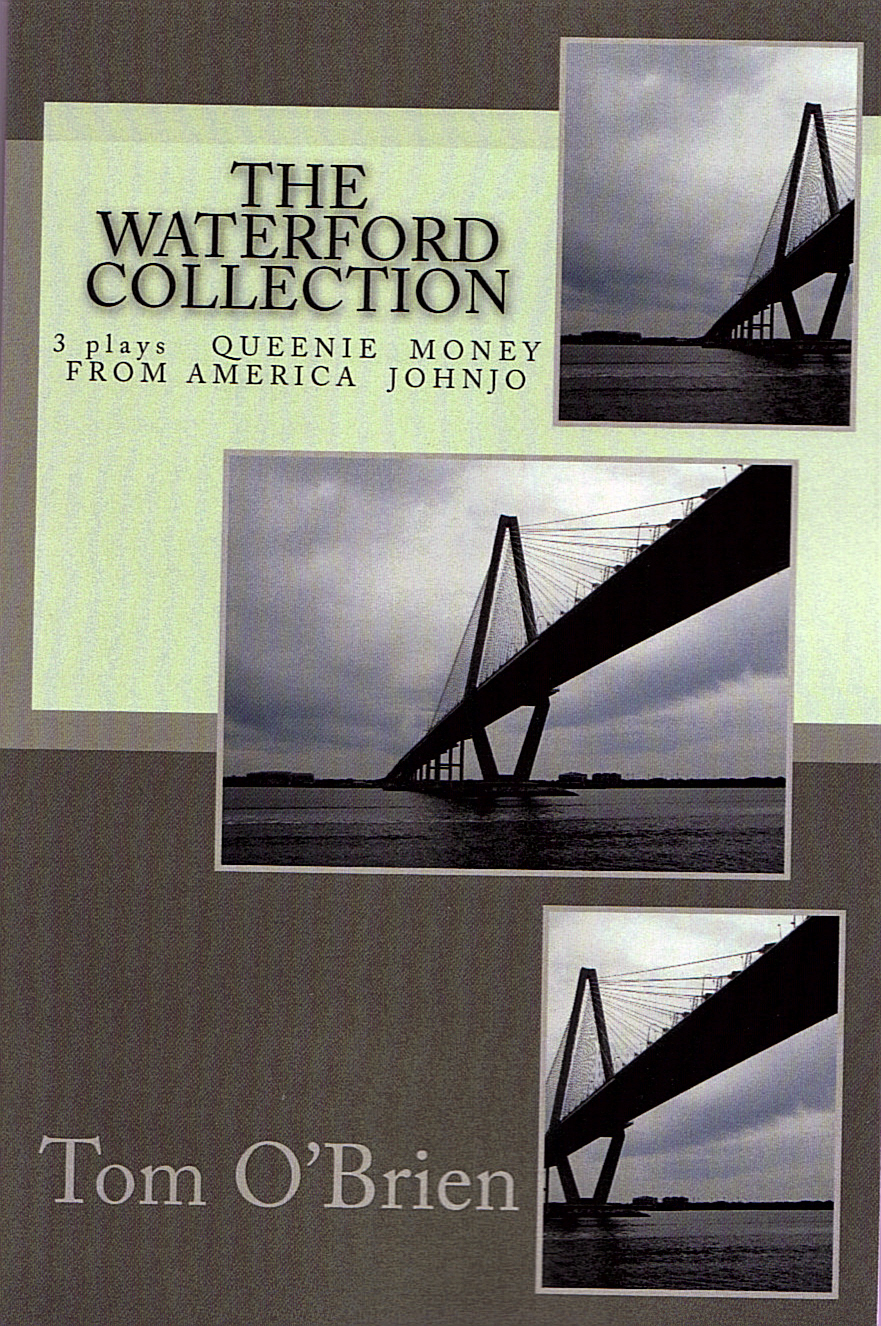
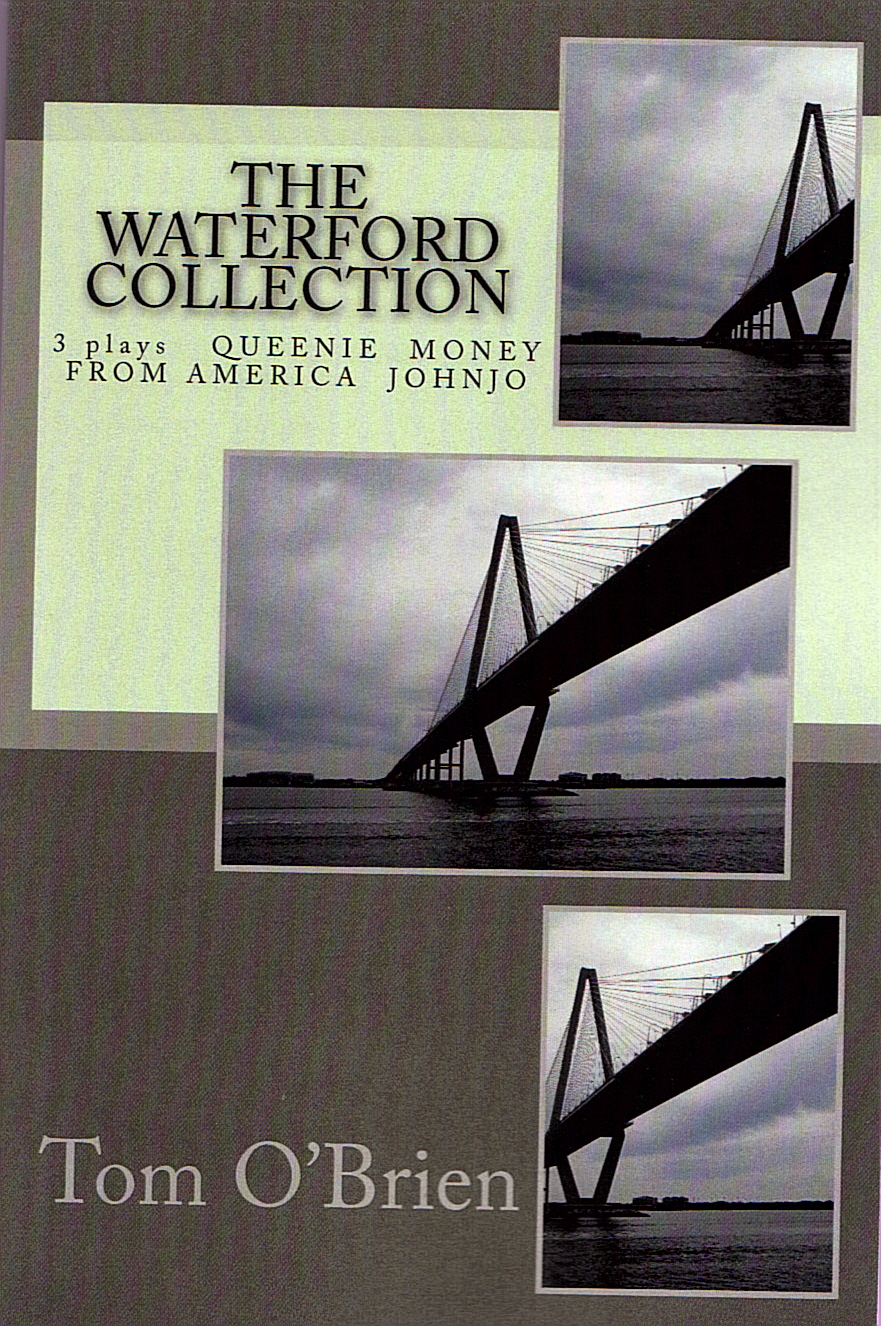
The cover is impressive with three pictures of the new bridge. The first play Queenie is a 5-hander and tells a poignant story of Victoria Dwan who has been institutionalised, and is now being ‘released’ back into the community. This features open-air stage dancing at Granagh Cross, as she wheels around an indigent accordion player in a pram. This seems so surreal and Beckettian, with a wild theatricality. Queenie is a troubled soul who has second-sight. The play is beautifully ‘threaded’ with music and songs.

The second play, Money From America, is a much darker play about two brothers and a farm. Lardy has spent a lifetime toiling on the Co Waterford farm for little reward, and his older brother Jack returns from America and sees the farm as his rightful inheritance. This conflict involves two female partners, who would not be out of place in a McDonagh play, and it has a dark and dangerous resolution.

The third play, Johnjo, is a one-hander, a monologue set in the late seventies, and is a study of Johnjo McGrath from cradle to grave, from the Comeragh’s to wartime England and the dark underbelly of the construction industry. This is a harsh unrelenting play, but it held my attention all the way, and it is filled with songs and music that is as nostalgic as it is ironic.

Such was the success of the recent Pentameters production that they will present another Tom O’Brien play in London in July, about the women in Brendan Behan’s life, and still no Waterford production.    Liam Murphy

available @  http://www.amazon.co.uk/Tom-OBrien/e/B0034OIGOQ/ref=sr_tc_2_0?qid=1388083522&sr=1-2-ent


WRITERS AND THE CHELSEA HOTEL

dylan thomas poet Dylan Thomas

Bob Dylan, Sid and Nancy, Leonard Cohen, Andy Warhol, Janis Joplin were among a long list of artists and musician who stayed at the Chelsea Hotel NY at one time, adding to its reputation as a decidedly bohemian enclave. Musicians and artists dominated the headlines through the 13 decades since the Chelsea’s construction in 1884. But the grand hotel-for-the-arts on New York’s West 23rd Street has inspired literary works as well, and often it was the writers who shaped the narratives on which artists working in other disciplines based their work. 

Below are a few of the writers who stayed there:

DYLAN THOMAS  “Excuse me,” Dylan Thomas apologized, following a terrible fit of coughing and retching into his rusty Chelsea hotel sink. He suffered from a medical condition, he explained. “I think it’s called cirrhosis of the liver.” The popular Welsh poet drank too heavily to produce much of literary merit during his numerous stays at the Chelsea Hotel.

BRENDAN BEHAN  Alcoholism had not only gotten the Irish playwright and novelist Brendan Behan kicked out of Algonquin and Bristol Hotels by 1963, it had also destroyed his ability to hold a pen. At the Chelsea, though, the choreographer Katherine Dunham and her dancers were able to nurse him back to health. At the Chelsea, the writer dictated Brendan Behan’s New York, a lyrical tribute to his favorite city, into a tape recorder when not singing Israeli songs with the poet Allen Ginsberg, dancing in the halls with Communist leader Elizabeth Gurley Flynn, befriending Eugene O’Neill’s ex-wife Agnes Boulton, or carrying on affairs with male and female lovers while managing visits from his long-suffering wife as well.
Learning from Roger Ebert through Brendan Behan Brendan Behan


JACK KEROUAC  It was one of those nights of “metropolitan excitements,” Kerouac wrote of the night in 1953 when he and William Burroughs encountered Gore Vidal at the San Remo bar. Already drunk with joy over the publication of Burroughs’s Junkie, the two writers eagerly incorporated Vidal into the night’s revelries. But as the drinking progressed, Burroughs peeled off–leaving Kerouac and his handsome fellow writer to muddle-headedly resolve to pay tribute to their predecessors Thomas Wolfe and Dylan Thomas by consummating their friendship at the Chelsea Hotel.

jack kerouac Jack Kerouac

THOMAS WOLFE  “The desire for it All comes from an evil gluttony in me,” confessed Thomas Wolfe, who had moved into the Chelsea on Edgar Lee Masters’s recommendation and whose rumbling, Southern-accented voice permeated the corridors as he paced the floor each night dictating scenes for a novel. To Masters, who invited Wolfe down for a nightcap occasionally, the writer seemed a force of nature, loudly decrying the changes he saw in his countrymen in the wake of the Depression. America had lost its way, Wolfe insisted.

ARTHUR MILLAR  Arthur Miller came to the Chelsea in 1962 to escape his disastrous marriage to Marilyn Monroe, but once he started writing, he found he couldn’t duck his history quite so easily. His new play, After the Fall, was meant to explore, in this post-Nazi era, the individual’s responsibility for the fate of a fellow human, but it soon became clear that Miller was also exploring his role in Monroe’s self-destruction. Even after the announcement of Monroe’s suicide, Miller denied the true identity of his play’s female protagonist.

arthur miller playwrightArthur Millar

ARTHUR C CLARKE In 1965, long-time Chelsea veteran Arthur C. Clarke checked in for a stint at the hotel, pounding out 2,000 words a day on a novel-length accompaniment to 2001: A Space Odyssey, his collaboration with filmmaker Stanley Kubrick. Kubrick had tried to work with Clarke at his own office in Manhattan, but after one day’s work the writer returned to the Chelsea to draw on conversations with William Burroughs, Allen Ginsberg, Arthur Miller and others for inspiration for his work. 

WILLIAM BOROUGHS  William Burroughs and his close friend, the Canadian artist Brion Gysin, arrived at the Chelsea Hotel in 1965 to market a new invention, the Dream Machine, a contraption consisting of a spinning paper cylinder with slitted sides and a light bulb inside whose purpose was to create a psychedelic experience for the viewer without the use of drugs. When it failed to make them rich, the pair turned to a new collaboration equally in tune with the Chelsea Hotel zeitgeist: The Third Mind, a exploration of the synergetic power of creative collaboration. 
SAVING THE BEST FOR LAST.

NO BLACKS, NO DOGS, NO POLES – Pentameters Theatre, London.

The quaint Pentameters Theatre of Hampstead is an ideal setting for director Jesse Cooper’s charming and intimate production of Tom O Brien’s No Blacks, No Dogs, No Poles. The play weaves a rich tapestry of cultural perspectives on the Irish diaspora, racism and immigration using the central storyline of the Kennedy family and their social dilemmas as a conduit. The use of space vividly reflects the claustrophobia of both the small minded views frequently depicted within the play as well as the closeness of the complicated relationships which play out on stage.

Having said this, despite the underlying tensions seen both in the tense relationships and strong socio-political opinions; there is great warmth in all of the actor’s performances. The combination of a very funny script and some larger than life performances allow the audience to feel like we have been invited into this Irish household free of airs and graces. The result is a lively and homely political dialogue full of both cliche and insight depending on which character is speaking. A script laden with Irish in jokes, music and family banter is thoroughly entertaining. Meanwhile, clever direction allows the audience to see through the comedic defence mechanisms key characters husband and wife Con and Marion Kennedy employ throughout to disguise their true feelings of despondency in an unhappy marriage.

The theme of home is juxtaposed throughout the plot as despite the deep rooted hatred Con (played by Matthew Ward) expresses about the English oppression of the Irish, his wife Marion ultimately feels that England is her true home. Similarly, the return of son Michael to this household where he no longer feels at home having lived abroad reveals the small minded opinions of his father. As Con shows prejudice towards Michael’s Australian black wife (beautifully played by Rachel Summers), the irony in his previous arguments about the English prejudices towards the Irish is exposed. Sam Turrell gives a brilliant performance as Michael; adopting with ease the measured diplomatic liberalism his character needed to show throughout to contrast the seemingly old fashioned views of his family and their friends. His apparent disgust and embarrassment at his Father’s prejudice and Jimmy’s aggression as well as his genuine attempts to protect his wife from it, seemingly represent a more modern take on ethnicity and immigration.

As well as the catalysts of Michael’s return, and the revealing of an ex-marital affair on the part of Marion, we then have the plot turn full circle as Con’s bisexuality is exposed by Jimmy. The fact that Con finally seeks emotional refuge in his homosexual relationship with a local black construction worker is the ironic icing on the cake so to speak! All in all, the play emphasizes some very relevant disputes about immigration today in a carefully crafted display of love and hate at their most extreme.

– – – – – – – – – –

Reviewed 07/06/14

By Emily Mae Winters
@emilymaewinters

20th May- 7th June 2014
Pentameters Theatre, London, NW3.

BUT THERE’S MORE!  MY NEXT PLAY – BRENDAN BEHAN’S WOMEN – ALSO OPENS AT PENTAMETERS NEXT MONTH. 1st – 20th JULY.  DON’T MISS IT!

THE WATERFORD COLLECTION – 3 plays

QUEENIE…MONEY FROM AMERICA…JOHNJO

All three plays are set in rural Waterford, in the shadows of the Comeragh Mountains.

QUEENIE is a woman who has spent much of her adult life in a mental institution and has now been released into the community. She possesses second-sight, frightening psychic powere, which in the past  had seen many in the locality label her a witch.

MONEY FROM AMERICA tells the tale of two brothers and a farm. Lardy has spent all his life eking out an existence in the family hill-farm; now his brother Jack is back from America to claim his rightful inheritance, which he plans to sell.

JOHNJO is the story of a man on the run from rural Ireland and his attempt to survive amongst the chaos of war-torn England. How long can he remain in the shadows?

see my amazon page for purchasing a copy and to read an extract; http://www.amazon.co.uk/Tom-OBrien/e/B0034OIGOQ/ref=sr_tc_2_0?qid=1388083522&sr=1-2-ent

Image