THE WRITING OF ‘DOWN BOTTLE ALLEY’

ADAPTING A BOOK TO A PLAYImage
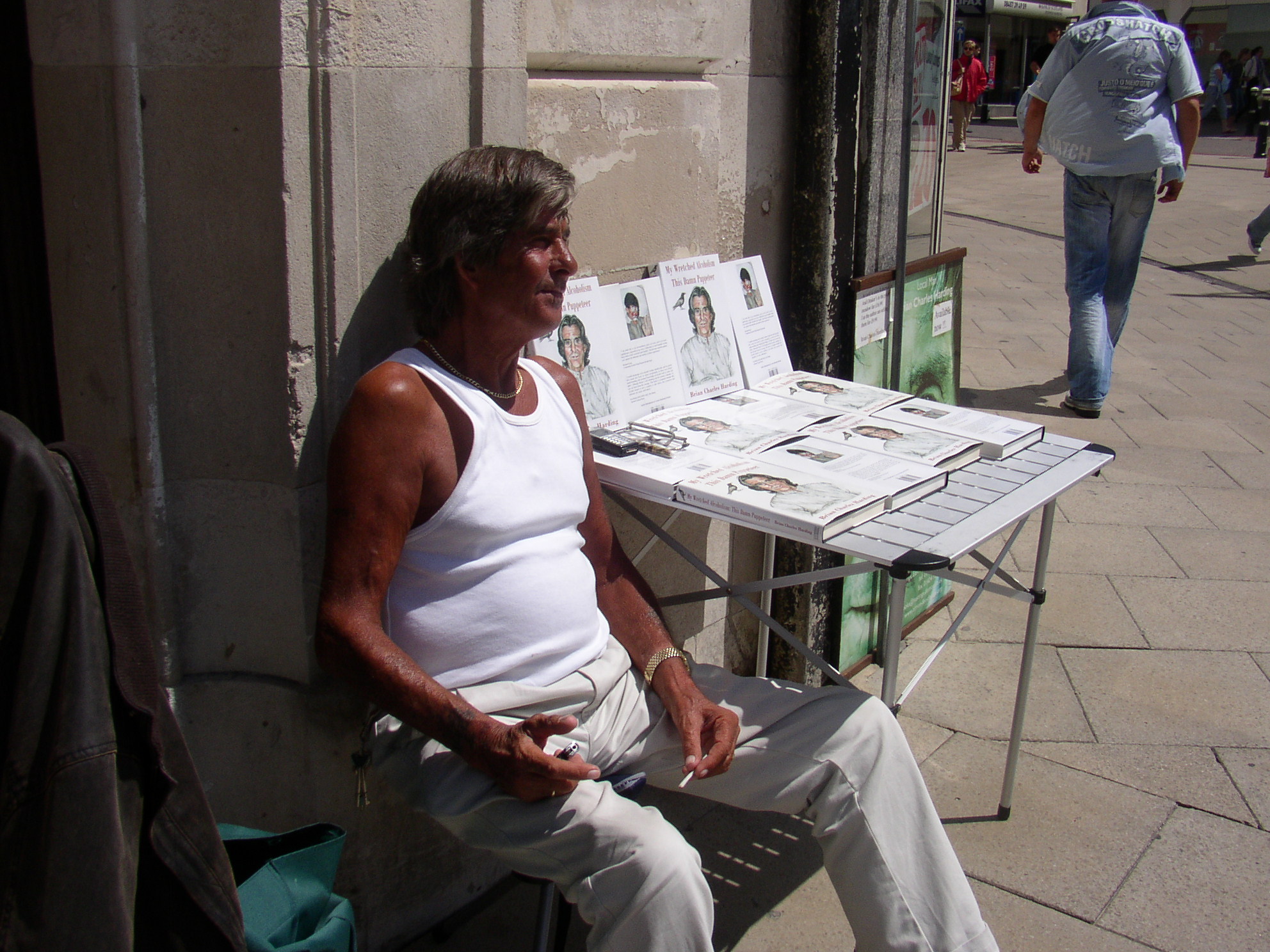
Brian Harding is an alcoholic. He is in his late sixties now and had his first drink in 1953, on Coronation Day. Sixty years on he is still drinking daily; it is killing him, but as he says ‘if I stop now it will kill me quicker’.

I first met Brian a number of years ago; he was selling copies of his book ‘My Wretched Alcoholism – This Damn Puppeteer’ outside Natwest Bank  in Hastings town centre, and I was persuaded to buy a copy.

It was a harrowing read, dealing as it did with Brian’s life as it spiralled ever downwards as he became addicted to drink, but I felt it was totally honest account , and he had portrayed himself warts and all. It appealed to the playwright in me; I felt it would make a very good stage play and felt a compulsion to adapt it. I spoke to Brian and he agreed, provided I promised him a production within a year. I promised – easier said than done! –  but to be honest at this stage I had no idea how I would accomplish it.  Still, I wanted Brian’s signature on that contract so I decided to worry about that little detail later!

Brian was a self-confessed street drinker, who once thought of Bottle Alley as his place of abode. It is still considered that by some alcoholics today – though it’s not nearly as bad these days – and when I visited it to get a feel for what I was going to write about I realised I had found the title for my play – Down Bottle Alley.

Bottle Alley

 In the early 1930’s Hastings tramways were ripped up to make way for a new promenade built in reinforced concrete. This double-decker promenade, which is approx half a mile long, and stretches from the Pier to Warrior Square, was the brainchild of  Sidney Little, Hastings borough engineer.

The lower walkway was built in a functional style, relieved by the decorative effect of the rear wall which was faced with coloured glass from broken bottles. The glass came from the council tip, where Little discovered a veritable mountain of discarded bottles. These were broken up and incorporated into the concrete slab which makes up the real wall. Close examination shows bottle fragment with the names of local brewers of the period, and it was long before it became known as  Bottle Alley. In later years it lived up to its name, being used as a meeting – and drinking –  place by the street drinkers of Hastings and St Leonards.

……………..

Brian’s  book began as a form of therapy and just grew until what finally resulted was a brilliant account of what it is like to be in the grip of ‘the demon drink’. His introduction  included this statement; ‘I have led a wretched life, neither producing, creating or contributing anything. My affair with drink has rendered me for the most part incontinent, impotent, and without any real place in this society. I still manage to keep clean but I don’t feel it. My wife’s friends treat me politely and with a respect that I feel is guarded, and with a false affinity. False in that everyone is an ‘aholic’ of some sort or another. They have no idea. I have no point of reference as to how life would be without drink. It seems I have always been steeped in drink. I am drunk now. I quite possibly won’t finish this story’.

I also now had my opening lines. A picture began to emerge; An older Brian talking about his life to the audience; a younger, more agitated Brian re-living some of the more important highlights – or low-lights; both of them seeming to be two different people, constantly arguing, haranguing each other. And other, varied characters to tie it all together.

 It would be different than the book of course; it would have to be as there was practically no dialogue in Brian’s book – and a play is comprised only of dialogue. It would still be Brian’s story, and of some of the other important people in his life, but I would have to put words in all their mouths! To do this I would need a framework; a set number of characters and events, presented in such a way that it made sense of Brian’s much more detailed examination of his life.

Some events in Brian’s story had more significance than others; His abuse as a child by his father, including urinating on him in a bath of cold water; his meeting with Lydia, a prostitute, at Charing Cross station; his marriage to his first wife Pat; his various ‘holidays’ in mental/psychiatric institutions like Heddingly; all these I re-imagined then fleshed out to give the story a dramatic impact on stage. Of course all of the wide range of characters that Brian came into contact with couldn’t be included, so I invented a couple of fictional ones which, in essence, were composites of the numerous real ones. Big Tone was one example; he is seen as Brian’s sidekick in the play, but he never existed in real life. Sally, a vagrant who inhabits Bottle Alley, is another one. But most of the events in the play did really take place.

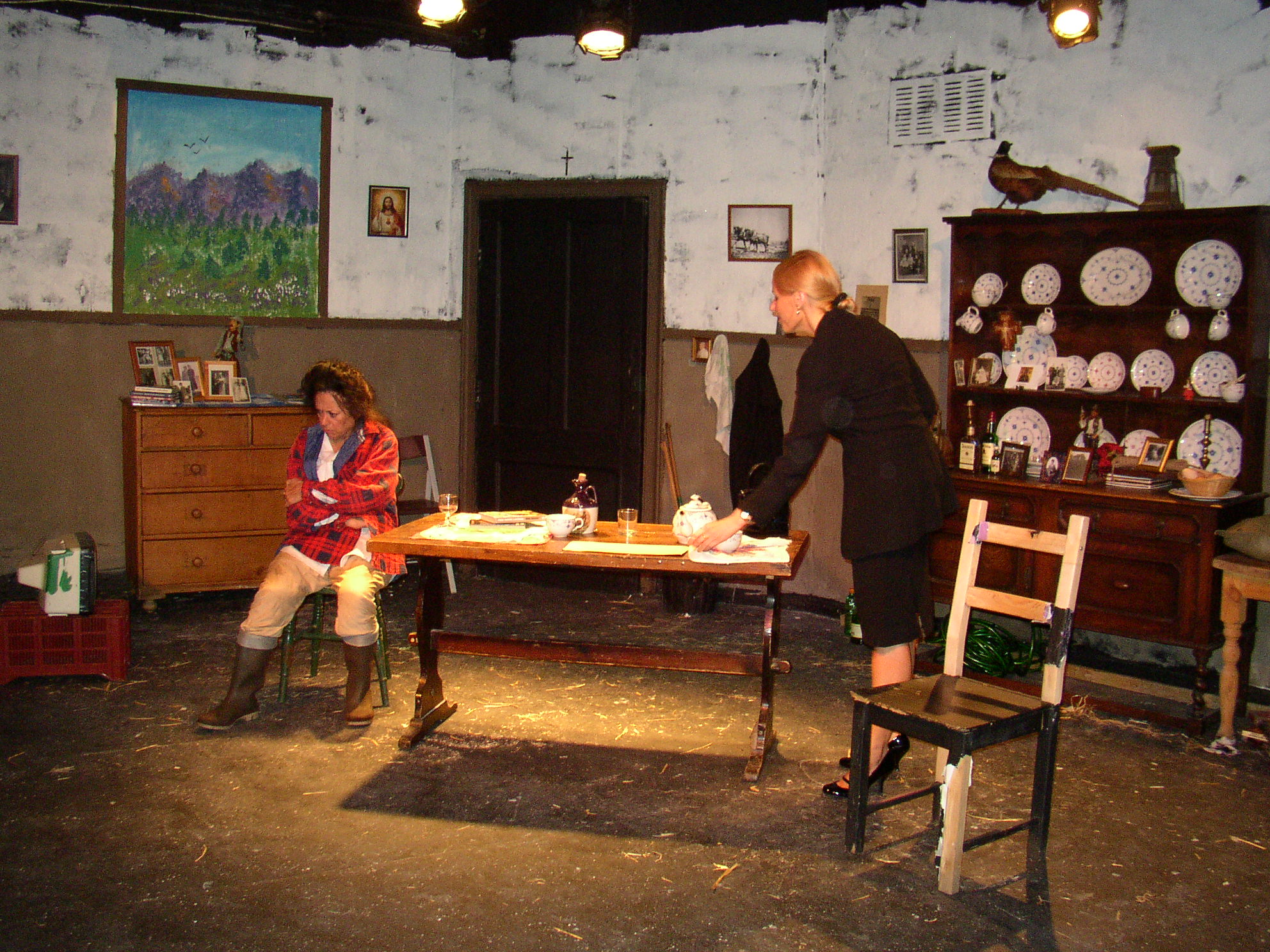
Finding a venue was easier than I expected; I contacted The White Rock theatre and they were more than happy to have us stage it there. They were very helpful with marketing and even printed and distributed posters for us throughout the town. However, I was nervous of doing it ‘cold’ in Brian’s  home town – well Brian was born in Sevenoaks but had lived for many years in Hastings and regarded it as home –  so I contacted a producer friend of mine in London. John Dunne ran a theatre company called Croft Productions and he agreed to try it out first at the Irish Centre in Camden.

 Brian was very excited by the idea of a play and decided to come to London for this ‘try-out’.  A really big crowd turned up for the performance and it proved a big success with the audience – the most touching part of all was the sight of Brian sitting in the front row, crying his eyes out throughout the performance. We were clearly doing something right.

The big night at the White Rock turned out a most extraordinary event. Over 200 people turned up at the downstairs venue – a sell-out – and we had a question-and-answer session afterwards, with Brian, John and myself fielding questions for over half an hour. Many people confessed that the story struck home; they all knew somebody – a friend or relation – whose story it could have been. It was Brian’s story but it could have been anybody’s, anywhere –  which only reinforces my belief that there are Bottle Alleys wherever you go.

This is an extract from the review written by Tony May for Hastings Town magazine;

‘What followed was….a play so brutally honest, so visually vivid and –worst of all – so terrifying real that there could be no hiding away from it…throughout the whole performance you could hear a pin drop.

James Lawes was especially outstanding. Having spoken to the real Brian beforehand I felt that his acting was utterly in time with the spirit, language and mannerisms of the man that it was unnerving. The constant shaking of the leg, the twitching hand desperate to hold onto the remnants of a fag butt, the mood swings, the physical  collapses – all were carried off to a devastating effect….’

 Image

On a sad note, Brian has since died. My book of the play, shown above is available on Amazon.


DAREDEVILS ON DARTMOOR


DAREDEVILS ON DARTMOOR

 Slowly, torturously they climb

Like some lumbering hippopotami

Up the rugged inclines

Spaced far apart

For decency’s sake

Their tinted windows

Glinting ominously from afar


At every vantage point,

A jutting rock formation,

A nestling valley far below,

Their mechanised progress

Becomes infinitesimal;

While flashing cameras eagerly

Gobble up the awesome landscape

From behind safe windows

And frame it forever

For some glossy album


‘I have been on Dartmoor’

They squeal delightedly,

The irrefutable evidence

Flickering in Technicolor

On their living-room walls

my latest book of poetry available from; http://www.tinhuttalespublishers.co.uk/67/


STREET SIGNS WITH A DIFFERENCE

THESE ARE SOME OF THE STREET SIGNS ‘MODIFIED’ BY FRENCH STREET ARTIST CLET ABRAHAM. HE WORKS BY PLACING STICKERS OVER THE EXISTING SIGNS, SO IF IT IS TERMED GRAFITTI THEN IT CAN BE EASILY REMOVED. AMAZING ART IN MY VIEW.

Image via Clet Abraham's Facebook Page    Image via UFUNK  Image via Clet Abraham's Facebook Page

Clet Abraham, Love HeartsClet Abraham, City Pigeon

Clet Abraham-Street Art-Signs-France-Paris-Florence-Italy-Rome-018

67 – A COLLECTION OF POEMS

67

67, my first collection of poems is now available as an ebook by Tin Hut Tales, and will be available as a paperback in about two weeks time

http://www.tinhuttalespublishers.co.uk/67/


JUST WALKING

 Walking…just walking

Away from the hum and drum

Away from the hub and bub

Away from the whine and grind of this rusty city

Couldn’t take it, they will say

Well, let them

This place isn’t all it’s cracked up to be


I saw a man today selling boxes to homeless people

Business was brisk

Did you know that the stone from the Pyramids

Would build a wall round England ten feet tall?

They say John the Baptist was gay

Funny the thoughts that come into your head when you’re walking


There was an old woman who lived in a hovel

She didn’t have any shoes but no one cared

She fell down one day

The hospital put her in a trolley for a few weeks

Then sent her away

Back to her hovel, her piss-stained bed, her broken radio

Her clock that didn’t tick, her bare cupboards, her solitary chair

Carried her up three flights, stood her in front of a walking frame

Said ‘take care of yourself, dear’


The whole fucking world anaesthetised by indifference


HOW TO WRITE ABOUT SEX

Here are 25 steps on the subject of writing about sex that are probably better than any I could dream up. I know, I am just a lazy bugger and couldn’t be arsed to use my imagination. Either that or I’m still in the missionary position!

http://terribleminds.com/ramble/2013/04/30/25-humpalicious-steps-for-writing-your-first-sex-scene-by-delilah-s-dawson-author-of-wicked-as-she-wants/

“Writing is like sex. First you do it for love, then you do it for your friends, and then you do it for money.” Virginia Woolf

Sex is interesting but not totally important. I mean, it’s not even as important (physically) as excretion. a man can go 70 years without a piece of ass but he can die in a week without a bowel movement. Charles Bukowski, Notes of a Dirty Old Man

Sex and a cocktail: they both lasted about as long, had the same effect, and amounted to about the same thing. D H Lawrence, Lady Chatterlesy’s Lover


DON’T MAKE YOUR HOUSE IN MY MIND


 Image

                                                         (scene from my play Money From America)


DON’T MAKE YOUR HOUSE IN MY MIND

 Oh yes, I saw what you wanted

From the very first day we met;

Your long legs wanton in the marram grass,

You promised sex without frills,

Your instincts more mothering than you know,

You delivered it without thrills


After the kids came it was respectability

And a job we could grow old in;

Our own home twenty years down the road

Everything borrowed along the way;

Freedom mortgaged for a safe house

Wasn’t such a big price to pay


All things come to pass in time;

The kids, the home, the income,

Shared lives going down the long slide

But their passing leaves a sour taste behind;

I should have made it clear from the start,

Don’t make your house in my mind


DOES YOUR POSTMAN ALWAYS RING TWICE?

Image

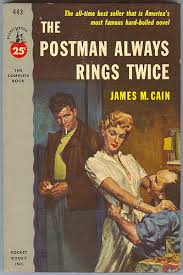
James M Cain, author of the best-seller THE POSTMAN ALWAYS RINGS TWICE said the book was so-called because when his postman was returning his rejected manuscripts he always rang twice

A few years ago, Samuel Moffie submitted The Perfect Martini to 100 literary agents. Actually, he submitted  the first twenty pages of Kurt Vonnegut’s Breakfast of Champions disguised as The Perfect Martini. Only one agent responded positively, but that’s because the agent recognized the original author. 99 agents declined.

Which just goes to show, what the fuck do agents know!  Or care.

Agents are concerned with commercial viability, first and foremost. Literary quality is a secondary bonus. Now, if Vonnegut wrote a novel where a dominant vampire becomes master to a naive, submissive, shape-shifting werewolf, I’m sure he would have fared better.

Why spend months, or even years, writing and submitting queries to agents who are clearly looking the other way? If they passed on Kurt Vonnegut, what chance do you have?

Brian Marggraf writes in his blog; I queried over 300 agents, followed all their silly and varied submission requirements, I know, no attachments, got it, waited to hear back for weeks sometimes, other times, didn’t hear back at all, even with partial or full manuscript requests, read all their canned responses, I’m not taking on new authors at this time, the work doesn’t fit with my list. Blah, blah, blah. My tip – don’t send any more. Take your work straight to the reader.Within one month, I built a platform, designed my cover, formatted my ebook, published, promoted, marketed, and advertised. Made sales.

He has got a point. And my postman? Yeah, the fucker always rings twice.

GUT FEELING ON THE THEORY OF EVOLUTION

GUT FEELING ON THE DUCK THEORY OF EVOLUTION

In the beginning there was silence

Slow symmetry break-dancing in the bleakness

Time’s arrows curving beyond comprehension


Soon, the dance of geometry commenced;

Atom, electron, proton, neutron,

Wave upon wave

Spin particle, spin!


Then into the melting pot

The first sounds of all our futures;

Quark, quark, quark, quark, quark, quark…


NEIGHBOURLY ADVICE FROM WRITERS

The first draft over everything is shit– Ernest Hemingway

There speaks one of the greatest writers of the twentieth century. Some advice, such as the above, is common sense, and some, such as this ‘write about what you know’ is shit. If all writers followed that advice how many great books would have been written? Would Orwell have written 1984? would Terry Pratchett have written any book at all? would Shakespeare have written Julius Caesar?  The list goes on. Write about what you don’t know might be more appropriate!

There are three rules for writing a novel. Unfortunately, no one knows what they are. ― W. Somerset Maugham

The following 21 tips may offer some insight – but I wouldn’t bank on it! 

21 Harsh But Eye-Opening Writing Tips From Great Authors

to purchase or read extracts from any of my books click on my Amazon page; http://www.amazon.co.uk/Tom-OBrien/e/B0034OIGOQ/ref=sr_tc_2_0?qid=1388083522&sr=1-2-ent


NEW WAVES

Image

NEW WAVES

To hear someone say;

I worked my fingers to the bone

So someone sharper could take my home,

Raises few eyebrows these days


Work isn’t the toad

Work is the poor man’s load

Piled up all his life ahead

Never relenting until he’s finally dead


You could of course ignore it;

No mortgage, no gadgets that comfort

No requirement to pay-as-you-earn it;

A kind of existence

Image