I WON’T BE ON HERE MUCH THIS WEEK AS MY NEW PLAY OPENS TOMORROW AND I WILL BE OCCUPIED WITH THAT.
NORMAL SERVICE SHOULD RESUME NEXT WEEK! ,
,
I WON’T BE ON HERE MUCH THIS WEEK AS MY NEW PLAY OPENS TOMORROW AND I WILL BE OCCUPIED WITH THAT.
NORMAL SERVICE SHOULD RESUME NEXT WEEK!,
LACKENDARA by Tom O’Brien
Ah Lackendara
You heard the voices too
At Passchendaele where you
Cowered as the big guns
Bombarded your world to silence
Blasted your thoughts to kingdom come
And left you forlorn
On that ragged outcrop
In the foothills of the Comeraghs
The fox and the curlew your only companions
The gurgling Mahon Falls
All there was to quench your thirst.
For thirty years you trod those hills
Taking little notice
Of ordinary life around you going on
Your presence on the mountain a constant reminder
Of mans’ inhumanity to man.

Jim Fitzgerald, ‘Lackendara’, with an unknown female.
Jim Fitzgerald, known as ‘Lackendara’, lived halfway up the Comeragh Mountains for over forty years. His home was a cave of sorts, with a roof comprised of bits of driftwood, stones and soil, and an entrance concealed by strips of hanging grain bags. A veteran of WW1, where he was said to have suffered shell-shock, he spent the remainder of his life in isolation in this rugged and unforgiving terrain in the foothills of the Comeraghs. He was known as a hermit, though he did venture down to the nearby village of Kilmacthomas every few weeks to collect and spend his pension on some essential groceries etc, but he never dwelt longer than was necessary, happy, it seems, to be back in the isolation of his Comeragh home, where sheep, foxes, and other wild animals were his only companions.

Jim Fitzgerald with Marcela Kirwan in 1955
The only time I ever saw him was in 1958, when a group of us were on a day’s trekking from the Technical College in Portlaw. We had cycled the 10 miles from the college to Mahon Falls, an amazing spot where the river mahon gurgled and rushed down the craggy rocks, before forming the river proper. We had spent most of the day climbing the mountain to get to Coumshingaun, a silent, eerie lake which was near the top, and to investigate Crotty’s Eye, a needle-like projection nearby, where the highwayman, Crotty, watched weary travellers negotiate a treacherous pass through the foothills, before way-laying them and robbing them of their money and valuables. Crotty was eventually hanged for his crimes in Waterford City.
On our way back down we saw Lackendara in the distance, heading for his ‘home’ which was nearby. He didn’t see us because there was a large boulder between us and he was pre-occupied with a fox, which had been following him. He stopped and gave it some food from a bag he was carrying, before patting it on the head and disappearing inside his cave. The fox finished eating then trotted in to the cave after him!
Lackendara died the following year, aged 68.
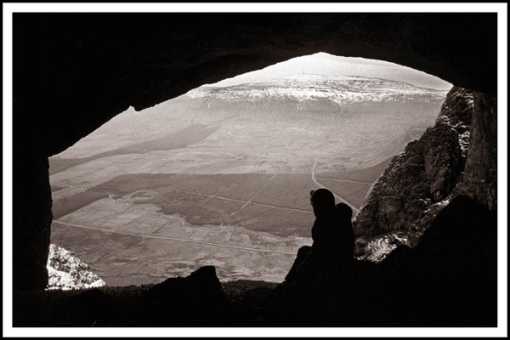

BOY
You won’t remember this
But I will
You changed again, got bigger
Both in body and in mind
One foot is the man you want to be;
The other is the boy
You so carelessly leave behind
from my latest collection of poems, ’67’. http://www.tinhuttalespublishers.co.uk/67/
Rehearsal pictures of NO BLACKS, NO DOGS, NO IRISH POLES, taken at Pentameters Theatre
All photos are by SIMON PURSE
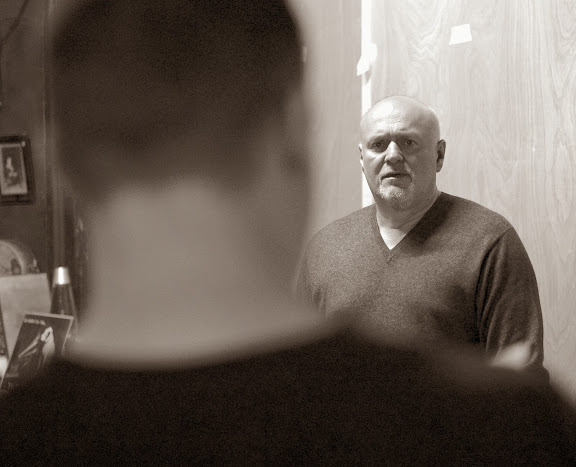 Matthew Ward as Con
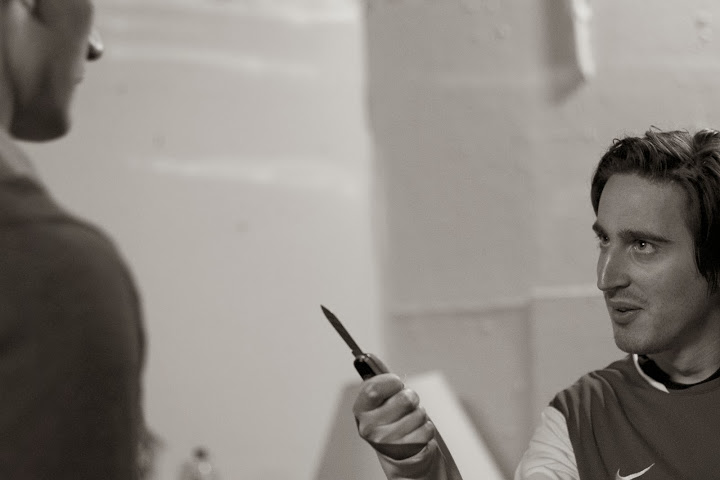 Jack Badley as Jimmy
 Rachel Summers as Cathy & Lucy Aley-Parker as Marion
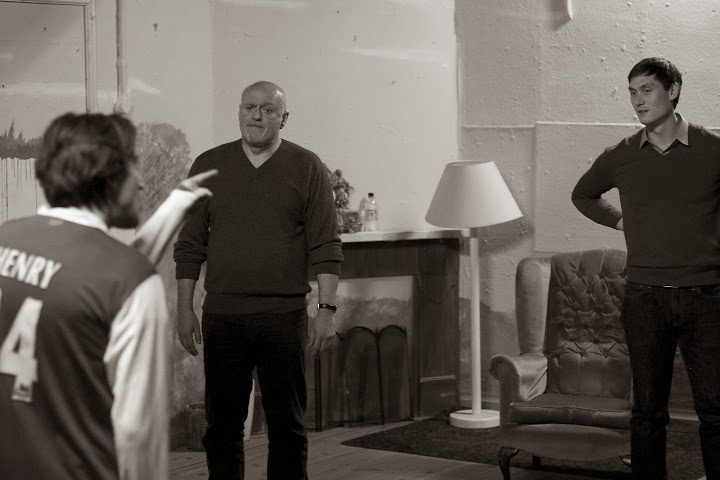 Jimmy, Con & Nathaniel Farnington as Michael
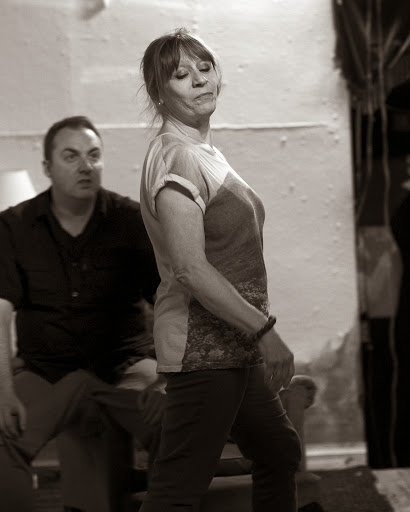 Jesse Cooper as JJ with Marion
BISEXUAL FATHER + RACIST COUSIN + ABORIGINAL WIFE = RACISM AND BIGOTRY IN IRELAND. DONT MISS!

VIADUCT IN PONDERS END
If I were a sheep
Picking a living on this canted grass
I might wish to communicate with my friends,
Similarly pitched across the way,
But would be unable to do so,
Barred by this tarmac valley
That gouges its way between us
Conversation would be useless in any case;
This crew-cut corridor is filled
With the tuneless dissonance
Of steel engaging steel
The cadences of piston power reverberating
The never-ending whine and grind
Of this rusty city…
If I were a sheep
I think I would wear ear-muffs

from my new collection’ 67′. http://www.tinhuttalespublishers.co.uk/67/

Sexual intercourse began
In nineteen sixty-three
(which was rather late for me) –
Between the end of the Chatterley ban
And the Beatles’ first LP.
This is the opening verse of Philip Larkins classic poem Annus Mirabilis, a poem which I consider to be one of my favourites of all time. Larkin was generally acknowledged as curmudgeonly, and one of the most miserable men in England; he once said of himself that ‘deprivation is for me what daffodils were for Wordsworth’. He was an inveterate letter-writer, and those published after his death in 1985 reveal his right wing views and his racist language. Indeed one historian described him as a ‘casual, habitual racist and an easy misogynist’. He also had a taste for soft porn – though had he still been alive today I expect he would have graduated to the hard stuff! There is no doubt that he had lecherous tendancies; and he conducted three seperate affairs together during one period of his life. Tough cookie!
“Morning, noon & bloody night,
Seven sodding days a week,
I slave at filthy WORK, that might
Be done by any book-drunk freak.
This goes on until I kick the bucket.
FUCK IT FUCK IT FUCK IT FUCK IT”
He was born in Coventry in 1922, earning the title ‘the bard of Coventry, though he worked most of his life as University librarian at the University of Hull. He wrote two early novels before turning almost exclusively to poetry, although he did contribute a lot to Lucky Jim, the first novel of his great friend Kingsley Amis. His first published collection was called The North Ship, but it was his second collection The Less Deceived, that got him noticed.

They fuck you up, your mum and dad.
They may not mean to, but they do.
They fill you with the faults they had
And add some extra, just for you.
But they were fucked up in their turn
By fools in old-style hats and coats,
Who half the time were soppy-stern
And half at one another’s throats.
Man hands on misery to man.
It deepens like a coastal shelf.
Get out as early as you can,
And don’t have any kids yourself.”
Undoubtably one of England’s finest poets, he couldn’t stand pretentiousness and once commented; “I can’t understand these chaps who go round American universities explaining how they write poems: It’s like going round explaining how you sleep with your wife.”
MUSHROOMS
When I was knee-high to a man
And fields were free
We picked mushrooms
On mornings such as this
Barbed wire, where it existed,
Was negotiable.
Now the Stalag-masters have returned
And fenced us out
Or is it in?
from my new collection of poetry ’67’ – http://www.tinhuttalespublishers.co.uk/67/

Nobody heard him, the dead man,
But still he lay moaning:
I was much further out than you thought
And not waving but drowning.
This is the first verse of Stevie Smiths classic poem ‘Not Waving But Drowning’. That’s always the dilemna isn’t it? How to determine that the wave isn’t a cry for help. That brave smile could be a grimace in disguise, masking all kinds of pain and anguish. That stiff upper lip could be holding back a tidal wave of of worry.
Smith herself was often drowning when she appeared to be waving. Deserted by her father when she was three, she lived with her mother and her sister Molly in Palmers Green. She suffered from depression all her life and when her mother died when she was sixteen her aunt Madge moved in to look after her. She wrote in several poems that death ‘was the only god who must come when he is called’.
Stevie wrote 3 novels and 10 collections of poems during her lifetime and.although she never married, was said to have been George Orwell’s lover. She never quite abandoned the Anglican faith of her childhood, describing herself as a ‘lapsed athiest’, and one of her poems contains these lines; ‘there is a God in whom I do not believe/Yet to this God my love stretches’. She died in 1971 aged 69.
might as well finish ‘Not Waving but Drowning’!
Poor chap, he always loved larking
And now he’s dead
It must have been too cold for him his heart gave way,
They said.
Oh, no no no, it was too cold always
(Still the dead one lay moaning)
I was much too far out all my life
And not waving but drowning.

FALL
Autumn mornings are best;
The sun smiling low over the gasworks
Flighty leaves browning the common
Kites lark-high over the tree-tops
Coffee and a roll in the old rectory
And you by my side
from my new collection of poetry ’67’. http://www.tinhuttalespublishers.co.uk/67/
BISEXUAL FATHER + RACIST NEPHEW + ABORIGINAL WIFE = RACISM AND BIGOTRY IN IRELAND
DON’T MISS THIS NEW PLAY

Synopsis: The dysfunctional Kennedy clan are having a re-union. There’s the father, Con, a successful building contractor in London who has had to relocate back in Ireland because of tax irregularities in the UK. Con is secretly bisexual, although not-so-secret from his wife, Marion, who has known it all along and kept quiet about it. His estranged son, Michael, turns up after five years in Australia with Cathy, his new aborigine wife. To say his parents are surprised would be putting it mildly. His nephew, Jimmy, also turns up and it is soon apparent that his racist, bigoted views haven’t mellowed any as he has got older. We learn that he is there at Con’s invitation; his real reason being to spy on Marion, who Con suspects of having an affair. Jimmy also has his own agenda, selling crack/cocaine to the local drug users – a plan which backfires when the drugs, which he has buried in the back garden, are discovered by Michael, heightening the already tense atmosphere in the house. Add in JJ, construction manager for Con, whose attraction to Marion must be obvious to everyone except Con.
http://www.pentameters.co.uk/index.html

