LIVIN’ IT UP IN KILBURN & CRICKLEWOOD ETC.

LIVIN’ IT UP IN KILBURN & CRICKLEWOOD

By

Tom O’Brien


When I first came to Kilburn in the mid 1960’s my residence was a less than salubrious double room in house that had seen better days, run by a certain Mrs McGinty in Iverson Road. It was the sort of place where you wiped your feet on the way out.

I was sharing the room with Vince Power – later of Mean Fiddler fame – with whom I had gone to school with in rural Waterford in a place called Newtown. Newtown comprised of a couple houses, the church, the school, two pubs, and a sweet shop, so the culture shock of walking down Kilburn High Road for the first time was quite something!

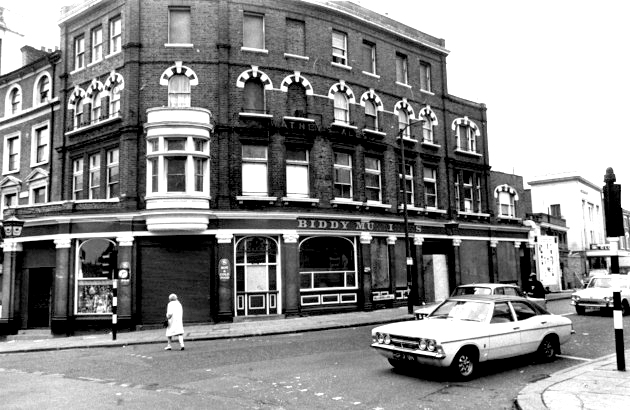
Within a few hundred yards I had seen two cinemas, The State and The Grange – monoliths of stone from a bygone era – an Irish dance hall, The Banba – and numerous pubs with names like The North London, The Black Lion, Biddy Mulligan’s, and so on.

There was also a Wimpey Burger Bar on the High Road, with a notice board just outside on the pavement which advertised rooms to let. It was here that I first read the legend ‘NO BLACKS, NO DOGS, NO IRISH’ It was also the first time I had seen black people in reality. I began to wonder what I was letting myself in for.

Vince was soon working as a floorwalker in Whiteley’s department store in Queensway, while I had got a job in the accounts department of Smiths Radiomobile factory in Cricklewood. In between times we listened to music from Vince’s collection of Buddy Holly and Patsy Cline records.

Cricklewood, too, had an Irish dance hall, called The Galtymore, and it was smack in the middle of the Broadway.  Big and bawdy It had two dance floors, one for modern music and one for Irish dancing, and was nearly always filled to capacity. And just a stones’ throw away was The Crown, even bigger and bawdier, and full of thirsty Irishmen washing the dust down after a hard day digging holes or pulling cables all over London and outlying areas.

Oh the crack was good in Cricklewood, but t’was better in the Crown

There were bottles flying and Biddies cryiing, and Paddies goin’ to town

Oh mother dear I’m over here, I never will go back

What keeps me here is the rake of beer, the women and the crack

The words of ‘McAlpines Fuseliers’, Dominic Behan’s homage to the expat shovel brigade, were regularly ringing in our ears as Vince and I danced our nights away at The Banba or the Galtymore. And sometimes our afternoons too; for there was a Sunday afternoon tea dance at the Banba, where hung-over Irishmen could sober up for the night ahead!

This was also the era of The Sunshine Gang, a group of expat thugs that plagued the area at the time. Said to have originated from the Longford/Westmeath region, they were into protection and other criminal activities. If bar and shop owners didn’t pay up they basically came in and smashed the place up.

The Banba, which was up an alley off Kilburn High Road was attacked during one tea dance while we were present; they wedged a Mini in the entrance, beat up the doorman, then started smashing up the hall inside. They were looking for Michael Gannon, the owner, who had presumably forgotten to pay his ‘subscription’.  They left after a few minutes, having no doubt been paid! They occasionally put in an appearance at the Galtymore as well!


We weren’t long getting to know the pubs in the area. Biddy Mulligan’s was a favourite of ours, as was The Admiral Nelson in Carlton Vale, owned by  Butty Sugrue. Butty originated from Kilorglin in County Kerry and was a Circus Performer cum-wrestler-strongman-publican-entrepreneur. He had toured Ireland with Duffy’s Circus, billed as Ireland’s strongest man and in Kilburn he had pulled red London buses up the High Road with the rope held between his teeth! A couple of years after we arrived, he had his barman, Mick Meaney, buried alive in a yard adjacent to the pub, where he remained for 61 days – a Guinness Book of Records world record. ‘Resurrection day’ saw thousands line the High Road as Mick was proudly paraded through Kilburn in the back of a truck.

There was always plenty of singing and dancing at The Admiral Nelson, and Jack Doyle was frequently seen at the venue singing for his supper. Jack had slipped a long way down since his heydays when he had fought for the British Heavyweight boxing title, or when he had been feted in Hollywood before marrying Mexican actress Movita, the couple moving to London, where they toured the country singing and performing to delirious audiences, and becoming the 1940’s  equivalent of Posh and Becks.

The bigger they are the harder they fall is a well known saying, and Jack eventually fell further than most. Whenever anyone asked him what caused his downfall he always replied ‘fast women and slow horses’. Some years later he would be found dead in a park in West London, penniless and shoeless. Listening to Jack and Movita singing together would send shivers down your spine.  Listen on the link below


Eventually Vince and I moved on to Harlesden where the 32 Cub in Harlesden High Street was the Mecca for the Irish population. Situated next to the Elm Tree pub on the High Street, in the building that was formerly the Picardy cinema, it was heaving every weekend.

By now Vince had met his first wife, Theresa, and before too long they got married and had a  child. Somehow, I managed to miss the wedding!

A few years later I was married myself (1971) and Vince was my best man wearing a suit borrowed from his brother-in-law! Yes, he was that poor!

In between times a lot had changed in our lives; Vince was now working in demolition, knocking down rows of terraced houses in the Willesden area, I had been a guest at Her Majesty’s pleasure for eighteen months, been deported back to Ireland and come back again, and had won a tidy sum of money with my regular Saturday bet on the ITV7 at my local William Hill’s betting shop!


Continue reading

MY GREAT-UNCLE MIKEY – WWI MEMORIES

51fVt749XiL


MY GREAT-UNCLE MIKEY

By

Tom O’Brien


This is an extract from my book LETTERS TO MOTHER AND OTHER DEAD RELATIVES, which is available to purchase on Amazon.co.uk


*************


Dear great-uncle Mikey,

When you marched off to war in the spring of 1915 did you know what you were fighting for?  Or did you care?  Was it purely on economic grounds – at least the British Army would feed you and keep you and put a few shillings in your pocket at the end of each week – or did you have an overwhelming desire to kill Germans? But perhaps it never even entered your head that you might end up in the green fields of France, a part of the greatest military slaughtering exercise that ever took place?

You certainly never thought you would lose a leg in it, or that your friend, JN, would lose his life there. I still don’t know where you enlisted or with what regiment, but I imagine the place was either Waterford city or Clonmel and the regiment either the Royal Munster Fusiliers or the Royal Irish Regiment. Was it a spur of the moment decision?  Did one of you say to the other – ‘come on, let’s join up, there’s nothing to do around this place?’ Was that how it was?  And how did your sister feel about J going away?  Or did J not know her then? Maybe it was later – when you were home on leave – that he met her?  You see how many questions there are? The only people who know the answers for sure are all dead now so I can only guess what they might be.

I wish you were still around in 1973, when an Australian singer called Eric Bogle was so moved by a visit to the WW1 memorials in France that he wrote a song called ‘The Green Fields of France’.  It begins:

Well, how do you do young Willie McBride?

Do you mind if I sit here down by your graveside

And rest for a while neath the warm summer sun

I’ve been working all day and I’m nearly done

I see by your graveside you were only nineteen

When you joined the great fallen in nineteen sixteen

I hope you died well and I hope you died clean

Or young Willie McBride was it slow and obscene

Chorus:

Did they beat the drum slowly, did they play the fife lowly

Did they sound the dead march as they lowered you down

And did the band play the Last Post and chorus

Did the pipes play the Flowers of the Forest.

There is more in the same vein but I am sure you get my drift. I first heard it sung by a group called the Fury Brothers. You would have liked the Furies; saloon bar musicians with voices like a load of gravel sliding down a chute. The eldest brother, Finbarr I think his name is, played your favorite instrument, the melodeon. You told me many times you carried yours around with you during the war, strapped to your back. And showed me the dent in it which had prevented a lump of shrapnel from injuring or killing you. I wonder if it was true, or if you made stories up for goggle-eyed young boys like John and myself?

I still remember the one you told about the ‘Big Push’ of 1917 – November I believe it was – when one of your comrades took out a German machine-gun nest with a grenade using the road bowling technique he had perfected bowling the roads in his native Cork. You said he had saved many of you from being slaughtered that day, and that he had subsequently been awarded the Military Cross.

I wonder now if you knew John Condon from Waterford, who is widely acknowledged as the youngest soldier ever to enlist in the British Army? He must have stood out because he was only 12 years of age when he enlisted, and still only 14 years old when he died during a gas attack in 1915. His burial plot in France is now a shrine, and one of the most visited of all the graves.  A shrine to what, I wonder…the folly of youth?


Your great nephew

Tom


Dear Mikey

I will call you Mikey if I may – It seems a bit daft calling you ‘grand uncle Mikey’ every time we speak. I have had information from sources in Cork about a JN from Kilmacthomas who died from his wounds in Flanders in August 1917 and I am now awaiting further information from them. I wonder if he will turn out to be my mother’s father?

My brother John (I am sure you remember John, everybody says he looked the spitting image of you when you were young) tells me he lived up the Portlaw road, five minutes walk from Carroll’s Cross – in which case you would almost have been next door neighbors.

I don’t suppose you would recognize ‘The Cross’ now. The pub is still standing – not yet quite derelict –  although the old building has been swallowed whole by the new additions. The old rickety stairs still survives inside, and the ring-board underneath. The open fire still presides; and the hob where you used to sit warming your’ large bottles’, spitting brown globs of chewed tobacco onto the red turf-bricks, watching as they hissed and bubbled for ages before being consumed, and where you sometimes played  half-sets and polkas on your melodeon.  You called your melodeon Julia; ‘me and Julia have been together for more years than I care to remember’, you used to say, lovingly. I wonder who the real Julia was?

The Creamery has gone too, as has the railway station. And the fields alongside the Bog Road, which saw sheep-dipping and traveling shows amongst their varied occupants in the past, are now the site of a Cold Store. Parts of Europe’s ever-growing butter and beef mountains are stored in vast warehouses in those once-thistly acres – courtesy of the EEC. But of course you wouldn’t know anything about the EEC, although what you fought for in WW1 – if you ever knew what you were fighting for, or indeed cared – may have had some bearing on its formation.

And the New Line is busy all day long now with traffic hurtling between Waterford and Cork and every point north, south, east and west on the compass. I remember the time when cars were rarer than steak dinners around the place; the horse and cart, the bicycle and shanks mare were the favored means of transport. Only parish priests had cars – and big farmers. And what still remains of Queally’s hill sees a constant stream of ready-mix lorries depleting still further the ozone layer that you never knew or cared about.

I suppose you remember my father drawing loads of stones from there in our ass and cart when I was young.  Maybe you helped us fill up for all I know. Why he had to come to Carroll’s Cross for stones I don’t know; we had plenty of them up our own boreen and in the fields and groves nearby, but maybe it was an excuse nip into the pub for a few ‘large bottles’. I can’t remember what he wanted them for now; I suppose it must have been for building one of the outhouses. Or for the new outside toilet that he was constructing.

Toilets were a luxury in those days as far as I could see.  I didn’t know anyone who had one – outside or inside. We couldn’t have an inside one anyway because we had no running water. We didn’t have much of anything then; no running water, no electricity, no car, you name it we didn’t have it.

Father had got around the lack of running water by build a tank on top of the roof of the new toilet. This got filled either by rain, or by drawing water from the well in our ass and cart. I suppose we must have felt like Kings or Queens when the new toilets were eventually finished; it beat into a cocked hat going across the fields with a newspaper or toilet roll under your arm.

Your great- nephew

Tom


Dear Mikey.

I expect there was a big hooley in Carroll’s Cross the night before ye left for Waterford to join the Royal Garrison Artillery. I now know that JN was a gunner – was that your rank too? What made you pick the RGA? Was it the notion of operating those big battering rams of guns?  I see that your unit was the Ist Trench Mortar Battery, so I guess you must have been in foxholes, lobbing mortars across no-mans land, hoping to splatter the misfortunate on the receiving end all over the French countryside. How much damage could those 14lb-ers do to captive recipients cowering in their already-dug graves? But I guess that wasn’t your concern; your main priority was to stay alive and healthy enough to man the guns to enable them continue their bombardment

When did you find out about the Easter Rising of 1916? I expect you were in one of your ‘fox-holes’ when it all kicked off? I have often wondered since if you would have taken up arms against the British had you been around. Don’t you think it’s ironic that you were killing Germans for the English at the time that they were pounding the bejaysus out of a few hundred republicans behind the barricades at the GPO and at Bolands Mills in Dublin? And probably with similar guns to the ones you were manning.

Eighteen thousand men and a gunboat up the Liffey to put down what some have since described as a ‘minor disturbance of the peace’? How did you feel when they lined up Pearce, Connolly and the rest of them against the walls of Kilmainham goal and shot them in cold blood?

And then a few years later the civil war started, you must have been asked to take sides again. Who were you for?  Collins or De Valera? You must have been in demand, even minus one leg, because you knew about shooting and killing – which is more than many of the others, did. Were you a trained killer, Mikey? Did the British Army show you how to kill your fellow human beings without mercy, and without any feeling of emotion?  I suppose they must have.

But tell me, you must have felt some emotion when his own countrymen at Beal Na Blath ambushed Michaels Collins?

‘Twas on an August morning, all in the morning hours

I went to take the morning air all in the month of flowers

And there I saw a maiden and heard her mournful cry

Oh what will mend my broken heart, I’ve lost my Laughing Boy

That’s a sad song about Michael Collins – and I am sure you have sung a few verses of it yourself in your time. Do you think it true what they say about us; that all our wars are merry and all our songs are sad?


Your great-nephew

Tom


Dear Mikey,

More information arrived today about JN He came from Ballybrack, (sounds like I am the right track) and he enlisted in Waterford in the Royal Garrison Artillery regiment. He was a gunner in the 1st Trench Mortar Bty, and his service number was 3373.  Was that also your Regiment? The records show he was aged 23 when he died of his wounds at Flanders. Did you take part in that battle and was that where you lost your leg?

‘I hope you died well and I hope you died clean

Or young John Neill was it slow and obscene?’

I now know that J is buried in the Adinkerke Military Cemetery in Belgium, which is situated a couple of miles inland from Koksijde and about 20 miles east of Dunkirk.

I wonder, now, if you ever went back there in later years, just to say a proper goodbye? It must have been awful in those trenches; Dante’s Inferno endlessly repeating itself; missiles and gas raining down day in day out; the trenches themselves little better than cess pits when the weather was bad.  I read somewhere that by early1915 there was one continuous line of trenches over 400 miles long stretching from Switzerland to the North Sea. There was no way round, was there? You could only go forward or back.

I wonder if mother knew of her father’s last resting place, and if she ever visited him there? She was never out of Ireland in my living memory, but I do recall her saying she spent 6 months in London before she married father. Perhaps she made the journey then.

If I can establish that he was definitely my mother’s father then I plan to visit the cemetery. I will say a prayer for all of you.


Your great- nephew

Tom

MCMXIV, by Phillip Larkin

MCMXIV, by Phillip Larkin

Those long uneven lines
Standing as patiently
As if they were stretched outside
The Oval or Villa Park,
The crowns of hats, the sun
On moustached archaic faces
Grinning as if it were all
An August Bank Holiday lark;

And the shut shops, the bleached
Established names on the sunblinds,
The farthings and sovereigns,
And dark-clothed children at play
Called after kings and queens,
The tin advertisements
For cocoa and twist, and the pubs
Wide open all day;

And the countryside not caring:
The place-names all hazed over
With flowering grasses, and fields
Shadowing Domesday lines
Under wheat’s restless silence;
The differently-dressed servants
With tiny rooms in huge houses,
The dust behind limousines;

Never such innocence,
Never before or since,
As changed itself to past
Without a word – the men
Leaving the gardens tidy,
The thousands of marriages,
Lasting a little while longer:
Never such innocence again.

BUNKER ON PORTLAND BILL

my poems BUNKER ON PORTLAND BILL appears on page 63

Click to access 2018-fall-preview.pdf


ADVICE TO A SON…Hemingway

ADVICE TO A SON  by Ernest Hemingway

Never trust a white man,
Never kill a Jew,
Never sign a contract,
Never rent a pew.
Don’t enlist in armies;
Nor marry many wives;
Never write for magazines;
Never scratch your hives.
Always put paper on the seat,
Don’t believe in wars,
Keep yourself both clean and neat,
Never marry whores.
Never pay a blackmailer,
Never go to law,
Never trust a publisher,
Or you’ll sleep on straw.
All your friends will leave you
All your friends will die
So lead a clean and wholesome life
And join them in the sky.

WORKING FOR THE SUBBY


The study of a man from the cradle to the grave. Forced to go on the run from his Comeragh hill farm at an early age, Johnjo washes up in Lincolnshire in war-time England. Working on farms, and often finding himself treated worse than the prisoners-of-war, he goes on the run again. And so begins a life-long association with ‘the lump’ – the dark underbelly of the construction industry. From building motorways and living in camps you ‘wouldn’t keep a decent dog in’, we eventually find him working in London for a ‘subby’ called Bannaher – not having been home to Ireland for more than thirty years. Disillusioned and bitter at having been ground down by the harshness of his life, he, nevertheless, hangs on to a few sparks of defiance. The final straw comes when he sees his friend (lover?) buried alive in the trench they are working in, and he embarks on a rebellious ‘last hurrah’.

MY CAR NOW TALKS TO ME.

MY CAR NOW TALKS TO ME
Hello
Goodbye
Raising the lights like a stage curtain
Playing little movies
Serenading me with melodies
The welcome – farewell experience
They call it
“An emotionally resonant experience”
And that digital note of appreciation
“Thank you for driving a hybrid”
As if it was something…well
Unconnected with this thing on four wheels.
And those door handles
Illuminating when they sense my presence
The needles on the instruments
Snapping to attention as I open the door
There’s a welcoming theme
Part Hollywood soundtrack
Part plane swoosh
And that puddle lamp!
A welcome mat of light.
My car is a robot I think
With a personality not just in its body
But also in its behaviour.
“How can I help you?”
It asks now
As I prepare for take-off.
I really feel like telling it
To shut the fuck up
But I don’t want to hurt its feelings.


AN ULSTER UNIONIST WALKS THE STREETS OF LONDON by Tom Paulin

An Ulster Unionist Walks the Streets of London, by Tom Paulin

All that Friday
there was no flag –
no Union Jack
no tricolour –
on the governor’s mansion.

I waited outside the gate-lodge,
waited like a dog
in my own province
till a policeman brought me
a signed paper.

Was I meant to beg
and be grateful?
I sat on the breakfast-shuttle and I called –
I called out loud –
to the three Hebrew children
for I know at this time
there is neither prince, prophet, nor leader  –
there is no power
we can call our own.
I grabbed a fast black –
I caught a taxi –
to Kentish Town,
then walked the streets
like a half-foreigner
among the London Irish.
What does it feel like?
I wanted to ask them –
what does it feel like
to be a child of that nation?
But I went underground
to the Strangers’ House –

We vouch, they swore,
We deem, they cried,
till I said, ’Out…
I may go out that door
and walk the streets
searching my own people.’


I WONDER WHAT THEY WILL SAY WHEN I AM GONE

480


I WONDER WHAT THEY WILL SAY WHEN I AM GONE.

I wonder what they will say of me when I am gone?

It was him that penned those lines, you know

The ones about choking the chicken.

Ah, poor Katie Doyle never lived that one down!

And the lies he told in that Altar Boy book he wrote

Just as well his poor mother wasn’t still around…


And how that Mean Fiddler fella was best man at his wedding

Wearing a suit borrowed from his brother-in-law


Then there was that tale about the Kray Twins

How he walked and smoked with them

On remand in Wormwood Scrubs if you don’t mind!

How they didn’t seem nearly as bad as they were painted

In fact he almost said they were kind!


I wonder what they will say of me when I am gone?

Perhaps they will say nothing


I THINK IT’S TIME FOR A REVOLUTION!


I THINK IT’S TIME FOR A REVOLUTION

I think it’s time for a revolution. I mean a real revolution; not those mickey-mouse ones of African or South American origin, but something like the French or Russian revolutions where a lot of heads and limbs got lopped off – and nobody knows  – or cares- even to this day,  where the bodies are buried. Harrowed by time, you might say.

The French revolution lasted ten years or so, and was propelled by Napoleon during the expansion of the French Empire, which saw the overthrow of the monarchy, the establishment of a republic, the removal of a lot of heads in the process, and ultimately, and ironically, a dictatorship under Napoleon.

Mind you, it did abolish slavery in the French colonies abroad, as well as expelling religious leaders and executing thousands of aristocrats.

The Russian Revolution came over a century later, and dismantled the Tsarist autocracy and led to the rise of the Soviet Union. It was two revolutions really; the first one seeing the abdication of Emperor Nicholas II and a provisional government installed, and a second one nine months later, seeing the Bolsheviks, led by Vladimir Lenin, seizing power, and ultimately becoming the Communist Party.


Both the French and Russian revolutions were bloody affairs; the Russian royal family were all shot on the orders of Lenin; the French king Louis XVI  and  Queen Marie Antoinette were guillotined.

So you want a revolution…off with their heads, I say!