GONZO MOMMA
Too weird to live, too rare to die
I guess that’s a creed
Old Hunter would swear by
Though he would have a drink first
Or maybe three
Then try to figure out where
The action might be
Before smoking some ‘stuff’
‘Cos he knew plain whiskey and gin
Would never be enough.
Then, perhaps like you, he would
Upheave everything and pack
Screaming all the while;
You can kiss my ass
I ain’t never coming back
Writing
ROLL ON TOMORROW!

come along if you can – it’s FREE!
PLAY ON

PLAY ON
Ensconced here in contemplation
Your presence overwhelms me
Arms outstretched, yet never chiding
Even knowing my ways were wrong
Burning both ends speeds up damnation
I can see that now;
Lust living in the wings
While the songs sang themselves
And courage dredged from the bottle
While the melody lingered on
Music was my life
But you changed it all;
Your song will still be nectar, Lord
When all this is gone…
ADVICE TO A SON – by Ernest Hemingway

Hemingway published around 20 poems in his lifetime – which is about 19 more than I expected!
Never trust a white man,
Never kill a Jew,
Never sign a contract,
Never rent a pew.
Don’t enlist in armies;
Nor marry many wives;
Never write for magazines;
Never scratch your hives.
Always put paper on the seat,
Don’t believe in wars,
Keep yourself both clean and neat,
Never marry whores.
Never pay a blackmailer,
Never go to law,
Never trust a publisher,
Or you’ll sleep on straw.
All your friends will leave you
All your friends will die
So lead a clean and wholesome life
And join them in the sky.

HOW TIME FLIES
This was the first performance of my first play. How time flies!
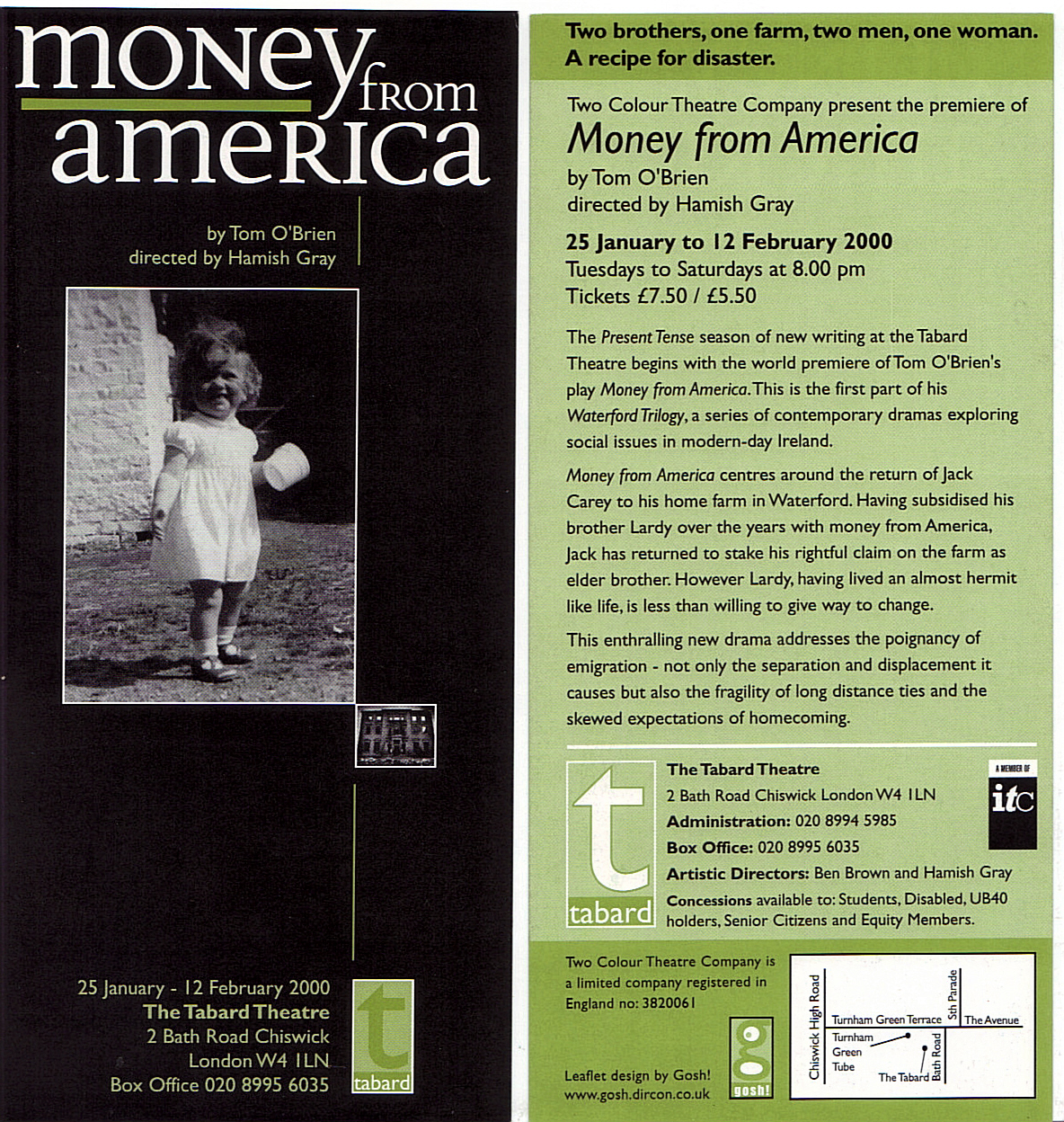
HOW TIME FLIES!
LOOKING FOR GOOGLE

LOOKING FOR GOOGLE
Driverless cars
Headless chickens
Oops! mind that blind…
Oh, what the Dickens!
The lingua franca
In Google we trust,
In God if we must.
Look, no hands!
It’s not a boast
It’s a statement of fact,
I don’t drive, it’s all an act.
The phone on my table
Speaks in eighteen different languages if tasked
And can answer questions
(Sometimes before they are asked).
Now they have sent ten thousand
Helium balloons into the stratosphere
Seeking all the disconnected;
Wi-Fi for all – and soon
They could – in theory – I guess
Set up shop nowadays on the moon
This is their ‘toothbrush’ test;
“Focus on the user and all else follows”
Culture and success go hand in hand;
If you don’t believe your own slogan
You’re already in no-mans land.
CUPID STUNTS


CUPID STUNTS
I see that I am at number 1,205,646
In the Amazon/Kindle best-seller list
Again
Last week I was at number 650,249
And the previous week 233,184
Or was that the week before?
I don’t think I have got into the top 100
Yet
I like to see the wild fluctuations in the list
Thousands of points variation
Mean lots of sales, innit?
Though I must confess
It puzzles me a little bit
Because according to Amazon’s
Own – very reliable – sales chart
I sold no books at all last week
And only one all last month
So Amazon/Kindle
Here’s my conclusion
You must be one cupid stunt
PARTING

PARTING
The sun also rises over concrete
Over this puff-adder sky
And the pricked-up chimneys
Looking like piss-horns in the stark morning
There are no shadows yet
On this marbled plain
So tender in years
But so sparing with love
I shiver at the bus stop
Admiring this proliferation of granite;
So cold, so hard,
So like you….
THE MORONIC INFERNO

THE MORONIC INFERNO
Oh yes,
The moronic inferno
Burns brightly these days
And nights
Almost as bright in fact
As the ever-glowing Northern Lights.
And the morons dance round their blazing fires
Hurtling insults to their hearts desires
Pontificating cluelessly,
About the economy – stupid! – and their messy
Sexual habits
With all the morals of a world of rutting rabbits,
And their institutionalised racism
Which they deliver verbatim –
I am not racist BUT…
What if the shoe was on the other foot?
MIRIAM – by Truman Capote

Miriam ~ A Classic American Short Story by Truman Capote
For several years, Mrs. H. T. Miller lived alone in a pleasant apartment (two rooms with kitchenette) in a remodeled brownstone near the East River. She was a widow: Mr. H. T. Miller had left a reasonable amount of insurance. Her interests were narrow, she had no friends to speak of, and she rarely journeyed farther than the corner grocery. The other people in the house never seemed to notice her: her clothes were matter-of-fact, her hair iron-gray, clipped and casually waved; she did not use cosmetics, her features were plain and inconspicuous, and on her last birthday she was sixty-one. Her activities were seldom spontaneous: she kept the two rooms immaculate, smoked an occasional cigarette, prepared her own meals and tended a canary.
Then she met Miriam. It was snowing that night. Mrs. Miller had finished drying the supper dishes and was thumbing through an afternoon paper when she saw an advertisement of a picture playing at a neighborhood theatre. The title sounded good, so she struggled into her beaver coat, laced her galoshes and left the apartment, leaving one light burning in the foyer: she found nothing more disturbing than a sensation of darkness.
The snow was fine, falling gently, not yet making an impression on the pavement. The wind from the river cut only at street crossings. Mrs. Miller hurried, her head bowed, oblivious as a mole burrowing a blind path. She stopped at a drugstore and bought a package of peppermints.
A long line stretched in front of the box office; she took her place at the end. There would be (a tired voice groaned) a short wait for all seats. Mrs. Miller rummaged in her leather handbag till she collected exactly the correct change for admission. The line seemed to be taking its own time and, looking around for some distractions, she suddenly became conscious of a little girl standing under the edge of the marquee.
Her hair was the longest and strangest Mrs. Miller had ever seen: absolutely silver-white, like an albino’s. It flowed waist-length in smooth, loose lines. She was thin and fragilely constructed. There was a simple, special elegance in the way she stood with her thumbs in the pockets of a tailored plum-velvet coat.
Mrs. Miller felt oddly excited, and when the little girl glanced toward her, she smiled warmly. The little girl walked over and said, “Would you care to do me a favor?”
“I’d be glad to if I can,” said Mrs. Miller.
“Oh, it’s quite easy. I merely want you to buy a ticket for me; they won’t let me in otherwise. Here, I have the money.” And gracefully she handed Mrs. Miller two dimes and a nickel.
They went over to the theatre together. An usherette directed them to a lounge; in twenty minutes the picture would be over.
“I feel just like a genuine criminal,” said Mrs. Miller gaily, as she sat down. “I mean that sort of thing’s against the law, isn’t it? I do hope I haven’t done the wrong thing. You mother knows where you are, dear? I mean she does, doesn’t she?
The little girl said nothing. She unbuttoned her coat and folded it across her lap. Her dress underneath was prim and dark blue. A gold chain dangled about her neck, and her fingers, sensitive and musical looking, toyed with it. Examining her more attentively, Mrs. Miller decided the truly distinctive feature was not her hair, but her eyes; they were hazel, steady, lacking any childlike quality whatsoever and, because of their size, seemed to consume her small face.
Mrs. Miller offered a peppermint. “What’s your name, dear?”
“Miriam,” she said, as though, in some curious way, it were information already familiar.
“Why, isn’t that funny—my name’s Miriam, too. And it’s not a terribly common name either. Now, don’t tell me your last name’s Miller!”
“Just Miriam.”
“But isn’t that funny?”
“Moderately,” said Miriam, and rolled a peppermint on her tongue.
Mrs. Miller flushed and shifted uncomfortably. “You have such a large vocabulary for such a young girl?”
“Do I?”
“Well, yes,” said Mrs. Miller, hastily changing the topic to: “Do you like the movies?”
“I really wouldn’t know,” said Miriam. “I’ve never been before.”
 My Writing Life