LOUIS MACNEICE – BAGPIPE MUSIC

Frederick Louis MacNeice 1907 –1963) was an Irish poet and playwright. He was part of the generation of “thirties poets” that included Auden, Spender and Cecil Day-Lewis nicknamed “MacSpaunday” as a group.                                              “Poetry in my opinion must be honest before anything else and I refuse to be ‘objective’ or clear-cut at the cost of honesty.” He has inspired many poets since his death, particularly those from Northern Ireland such as Paul Muldoon and Michael Longley

BAGPIPE MUSIC

It’s no go the merrygoround, it’s no go the rickshaw,
All we want is a limousine and a ticket for the peepshow.
Their knickers are made of crepe-de-chine, their shoes are made of python,
Their halls are lined with tiger rugs and their walls with head of bison.

John MacDonald found a corpse, put it under the sofa,
Waited till it came to life and hit it with a poker,
Sold its eyes for souvenirs, sold its blood for whiskey,
Kept its bones for dumbbells to use when he was fifty.

It’s no go the Yogi-man, it’s no go Blavatsky,
All we want is a bank balance and a bit of skirt in a taxi.

Annie MacDougall went to milk, caught her foot in the heather,
Woke to hear a dance record playing of Old Vienna.
It’s no go your maidenheads, it’s no go your culture,
All we want is a Dunlop tire and the devil mend the puncture.

The Laird o’ Phelps spent Hogmanay declaring he was sober,
Counted his feet to prove the fact and found he had one foot over.
Mrs. Carmichael had her fifth, looked at the job with repulsion,
Said to the midwife “Take it away; I’m through with overproduction.”

It’s no go the gossip column, it’s no go the Ceilidh,
All we want is a mother’s help and a sugar-stick for the baby.

Willie Murray cut his thumb, couldn’t count the damage,
Took the hide of an Ayrshire cow and used it for a bandage.
His brother caught three hundred cran when the seas were lavish,
Threw the bleeders back in the sea and went upon the parish.

It’s no go the Herring Board, it’s no go the Bible,
All we want is a packet of fags when our hands are idle.

It’s no go the picture palace, it’s no go the stadium,
It’s no go the country cot with a pot of pink geraniums,
It’s no go the Government grants, it’s no go the elections,
Sit on your arse for fifty years and hang your hat on a pension.

It’s no go my honey love, it’s no go my poppet;
Work your hands from day to day, the winds will blow the profit.
The glass is falling hour by hour, the glass will fall forever,
But if you break the bloody glass you won’t hold up the weather.

67 – A COLLECTION OF 71 POEMS

Now available on amazon

81lDM-3q7-L._SL1500_

POETRY REVIEW                            67 by Tom O’Brien
The Co. Waterford-born playwright and novelist, Tom O’Brien, who had two plays produced in London last year, has brought out a curious collection of poetry, titled 67. A collection of 71 poems from Tin Hut Tales Publishers. Written over a period of twenty-five years he describes them as  being “of their time” and some were written “in the heat of the moment”, scribbled on bits and scraps of paper on buses and trains, or on the building sites where he worked. There is a surge of anger, a sideswipe at society, and at other times tender memories of a rural Ireland he had left behind, knowing there was no golden dawn, no rose-tinted place to return to. At other times, the poems are like graffiti and have an instant savagery and frank use of language. At other times, they are like notes to the 20 or so plays and books he has written. Why he is not better known in his home county is still a puzzle to me.
The opening poem Russian Roulette As A Cure For Depression catches your interest ” The first time I pressed the trigger/ I knew I was immortal”. He has graffiti poems, Bollocks To The Poll Tax and an ironic transitional poem from a rural community to heartless urban wastelands in Put Another Log On The TV. Then a poem like Don’t Make Your House In My Mind, hits the sad side with lines like: “You promised sex without frills” and “Shared lives going down the long slide”. A poem like Old Acquaintance reads like the synopsis to a play, but it is a poem you will return to and find another ‘home truth.’
The Clonmel and Fethard writer Joe Ambrose, who went to college in De La Salle, in his story Shapeshifter, tells of Irish people moving to England, and it catches well the sentiment that Tom O’Brien tries hard to suppress – ” They tried to live in England, the bucolic Irish provincial lives they’d actually left behind on Paddy’s Green Shamrock Shore. Hillbillies let loose upon the slick city. Peasantry who like peasants all over the world lived to eat, shit, sing, breed and die”. Tom O’Brien catches that dichotomy time and again, especially in My Time – “This then is my time/ A ribbon of memories/ Stretching back to an age/ I can hardly remember/ Anymore”.
I am glad Tom O’Brien didn’t ‘tidy up’ these poems that echo a line ” Sorry sir, there is no more room for memories/The past is full up”.
I am also enthused that Waterford City and County Council have funded Stagemad Theatre to present a Tom O’Brien play later this year.
Liam Murphy  Munster Express

BRIEF ENCOUNTER ON A TRAIN


BRIEF ENCOUNTER ON A TRAIN

Blue-green compact

Hazel green eyes

She powdered busily

Then blinked in surprise

When  I winked

Not once, but twice

The train rocked on

She powdered her nose

She looked at me slyly

But I feigned repose

She stuck out her tongue

And I winked once more

Then the train came to a stop

And she dived for the door

BORN TO MISSS

BORN TO MISS

You see I came to everything too late

I missed the first train

I missed the last bus

I missed the sixties swinging

The Stones and The Beatles singing

I missed On The Road and Happy Days

Woodstock, Bob Dylan and the hippy craze

I missed the signals

That women give

Carnaby Street and I Want To Live

I missed double sixteen

More times than I can remember

And I missed the Lewis effigy-burning

Every bloody November.

HEMINGWAY’S HEAD

HEMINGWAY’S HEAD

Hemingway?

You know I always thought

He had a Romanian head on him

Romanian, how so?

Well, It had that bloated look to it,

And Romanian heads always

Look soggy, I think

Hemingway had it in spades..

‘Course it might be the drink, too

He could never pass a bar,could he?

Or it might be that time he landed on his head

In those two helicopter crashes he had

One after the other, the same day I think.

Split his skull open

Exposed his innards to those African parasites

Who knows what damage they did,

Rampaging around his grey matter.

He never said much about it afterwards

Though that twinkle in his eye

Often looked more like a twitch.

BARLEY LANE, HASTINGS

TAKEN EARLIER TODAY244 243 245 247 252

BARLEY LANE, HASTINGS, UK this morning

all my books are now available @  http://www.amazon.co.uk/Tom-OBrien/e/B0034OIGOQ/ref=sr_tc_2_0?qid=1388083522&sr=1-2-ent

WHO KILLED JAMES JOYCE?


//

Who Killed James Joyce? by Patrick Kavanagh

Who killed James Joyce?
I, said the commentator,
I killed James Joyce
For my graduation.

What weapon was used
To slay mighty Ulysses?
The weapon that was used
Was a Harvard thesis.

How did you bury Joyce?
In a broadcast Symposium.
That’s how we buried Joyce
To a tuneful encomium.

Who carried the coffin out?
Six Dublin codgers
Led into Langham Place
By W. R. Rodgers.

Who said the burial prayers? –
Please do not hurt me –
Joyce was no Protestant,
Surely not Bertie?

Who killed Finnegan?
I, said a Yale-man,
I was the man who made
The corpse for the wake man.

And did you get high marks,
The Ph.D.?
I got the B.Litt.
And my master’s degree.

Did you get money
For your Joycean knowledge?
I got a scholarship
To Trinity College.

I made the pilgrimage
In the Bloomsday swelter
From the Martello Tower
To the cabby’s shelter.

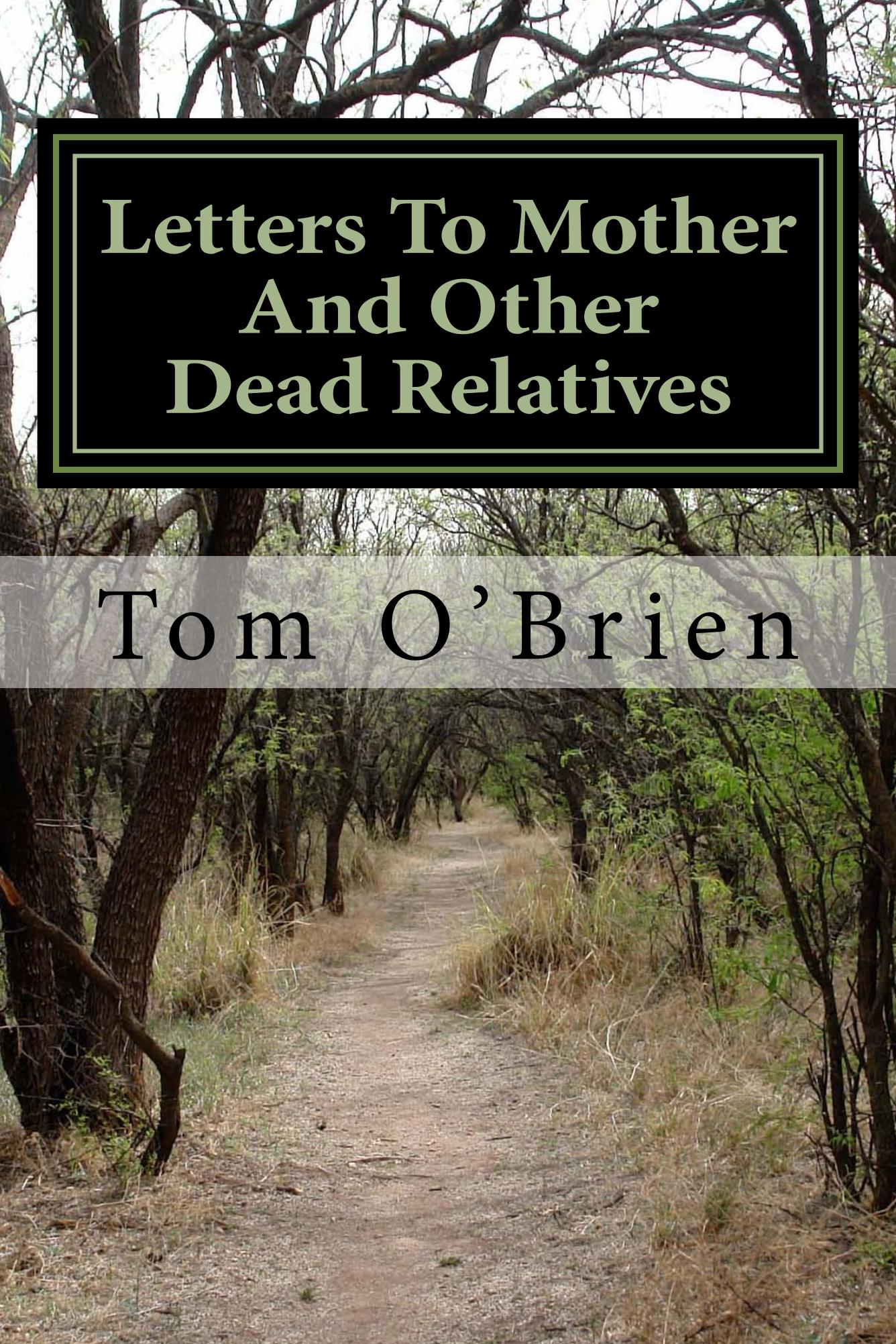
LETTERS TO MOTHER AND OTHER DEAD RELATIVES (extract)

Letters_To_Mother_An_Cover_for_Kindle

available in paperback or ebook on Amazon

Dear Mother,

We never had much to say to each other when you were alive. I suppose that had a lot to do with you being grounded in the tranquility of rural County Waterford, while I misspent my youth on the mean streets of that area of London often referred to as County Kilburn. Even when we did speak it was only in platitudes; nothing of importance was ever touched upon. Mainly, I assumed, because nothing of importance had ever happened in our family’s history. So the chances of you surprising me from beyond the grave were very remote indeed.

It began with enquiries about your favourite son, John. Telephone calls to friends and

neighbours, even to the Parish Priest in Newtown. Nosing around, you would call it. Eventually the caller phoned John himself, which is how I became involved.

Apparently we were the beneficiaries of a legacy. A substantial sum of money was laying in British Government coffers, the trail of which led back to our paternal grandfather, Tom, and we were the next in line. Nobody ever spoke about grandpa Tom; Why was that?  And now that I think of it, why is grandpa buried in one parish – Newtown – and grandma in another – Ballyduff? And why did father scrupulously care for grandma’s grave, and not grandpa’s?

But back to the legacy. There was a catch – there always is – the caller required us to sign a contract giving him 33% of the estate before revealing details to us. As I happened to consider that excessive for a ‘finders fee’ I began my own investigations on the internet.

As far as I could see, the only family member who it could possibly be was Aunt Margaret.

When I had last seen her ten years ago, she was already an old woman, living in poverty in Lewisham. (I know you always said she had loads of money, but if you had seen how she lived then you would have changed your mind)

Anyway, after several hours of queries to Ask Jeeves and co, I came across a British government website called www.bonavacantia.co.uk  I typed in a name and there it was in black and white! Margaret O’Brien…. Lewisham, died intestate 2005. Estate £XX,000 How well you knew her!

But of course you didn’t really. Nobody did. Not even my father – her own brother. He never spoke about her.  Why was that? She left Waterford in 1947 and was never seen by any member of the family again, apart from myself. Oh, I know you wrote her the occasional letter and she sent parcels of used clothes to you. ‘Her cast-offs’, you called them, before burning the lot.

What was it that caused her to go away and never come back?

She came to visit me in Kilburn shortly after Karen was born – was that your doing, giving her my address? – And we kept in contact until I moved away from the area. She liked the idea of having a niece, but I found her a strange, secretive woman.

When I last saw her she was housebound, living in a dingy council estate in Deptford. And given to calling me ‘Captain’ – because I don’t think she remembered who I was any more. After that I forgot about her.

To establish claim to the estate I have had to furnish various documents; birth, marriage, death etc. Which is how I learned that my father and Aunt Margaret weren’t the only children born to my paternal grandparents. There were three other children, John, James and Catherine. What

happened to those uncles and aunt? Father never spoke of them. They are not still alive as far as I can establish, but neither have I yet ascertained where and how they died and where they are buried.

But you, mother dear, served up the biggest surprise of all. On your marriage certificate, it says FATHER UNKNOWN. Why, in my childhood, did I never realize that your mother was unmarried? Or query the fact that your father had never been around. Oh, there was a man about the house – your mother’s brother Mikey – and maybe I subconsciously associated him with being  your father. Mikey, with his wooden leg -he had lost the real one fighting with the British Army in Flanders – lives on in my memory, and I can still recall trying to remove my leg as he did his, and wondering why I couldn’t. I almost wish now that he had been your father.

I have since learned that you did know your father. He was a friend of Mikey’s who had also joined the British Army, but had been killed in the same battle that had seen my granduncle lose his leg. Killed before he could make an honest woman of your mother.

Killed before he could respectably be put down on your wedding certificate as your father.

You never spoke about any of this. Not to me, anyhow. Was this what made you melancholy in your later years? The thought of your mother living all her life in her little thatched cottage in Grenan, the man she loved lying in an unmarked grave, lost forever in those green fields of France?

I think it’s sad that I find you more interesting dead than I ever did when you were alive.

Your loving son, Tom

  Continue reading

IN PRAISE OF MONARCHS

image34

IN PRAISE OF MONARCHS

He dug ditches in obscurity

Raised ten children to maturity

When pushed he said;

‘I do the best I can. Life’s hard

On the working man, but I mustn’t complain

I’ve got my health, while there’s others

Who can’t stop dying for all their wealth.

All that stuff in China…I wouldn’t give it

If they changed my lot for Royalty I wouldn’t live it.

There’s more to life than being famous you know’.

CONTEMPORARY POETS

MAURA DOOLEY

Poet and freelance writer Maura Dooley was born in Truro, England, and grew up in Bristol.

HISTORY

It’s only a week but already you are slipping

Down cold black chute of history. Postcards.

.Phonecalls. It’s like never having seen the Wall,

Except in pieces on the dusty shelves of friends.

Once I queued for hours to see the moon in a box

Inside a museum, so wild it should have been kept

In a zoo at least but there it was, unremarkable,

A pile of dirt some god had shaken down.

I wait for your letters now: a fleet of strange cargo

With news of changing borders, a heart’s small

Journeys. They’re like the relicts of a saint.

Opening the dry white papers is kissing a bone.