THE SHINY RED HONDA contd

I guess Ballyhussa was much the same as any other cross-section of countryside out in the middle of nowhere.  But to me it didn’t seem like that.  It was home and it possessed my young soul and my growing body.  I grew up there – and bits of me stayed there.  In the hedges and furze bushes; in the groves and ploughed fields; in the streams and ponds.  In the mass-path, in Newtown school, and in ‘The Bungalow’, with its patches of stony ground that we raked and raked but never could quite rid of stones.

On some mornings the Comeragh Mountains seemed to be in our back garden, on others they had retreated to another county. A mystery never fathomed by us youngsters.  Did all mountains move we wondered?  Their nearness signalled rain according to father; the further away they appeared the more settled the weather would be.  Like most country-folk he was an expert weather-forecaster – in his own eyes anyhow – and he cast his eyes heavenwards with the same frequency that people nowadays look at their watches. For my own part, I always found the animals more reliable. Cattle, sheep and dogs were no fools when it came to the weather, and could be seen scurrying for cover long before the storm-clouds appeared.

 Sometimes the tops of the Comeraghs were capped in a layer of snow so white it hurt your eyes to look at them, a sight that had the Master urging us to describe the view in poetic terms.   

            The Himalayas never looked so bright

            As the Comeraghs do tonight

             Their new overcoats bespoke,

              Overnight.

Eight miles in the other direction lay the sea. The Atlantic Ocean gnawing away at Ireland’s coastline like a hungry beast, according to the Master, sending currents of bracing air to collide with those sweeping down from the Comeraghs. The result was a fertile plain fit for both man and beast.

Most nights you could see light twinkling in the distance.  The bright city lights of Waterford, and, further away, the dimmer glow of Tramore.  Here, the Metal Man could be seen, sweeping the Atlantic with a raking beam every ten seconds or so.  Further along the coast lay Boatstrand, Bonmahon, Stradbally and Dungarvan, the latter just about discernible on a clear night.

Ballyhussa boreen was long and winding and Newtown village lay a mile and a half distant by road.  By the mass-path, however, it was less than half that journey. The mass-path was our regular route to the village and we had used it for going to school and mass for as long as I could remember. It began about a hundred yards from our cottage at the stile (a couple of stepping-stones leading into the field) and was a clearly defined path across the land until it reached the road just outside the village. I suppose that the cows who grazed there, and who quite often followed the path in our wake, helped to preserve it. However, even in later years, when much of the land was tilled, it could still be seen scything its way through shimmering corn. Its origin was never quite clear; it may have been a legacy of the penal times, or it may merely have been a long-established short-cut to the church in Newtown.

Going to school never took more than fifteen minutes, coming home could take hours.  The first couple of fields formed part of Michael Cummins’ farm, and this halfway stage was our usual stopping point.  This was mainly because it contained a small pond and was surrounded by clumps of bushes.  Depending on the season, there would be frogs’ eggs to inspect, birds’ nests to look at, Ice to be tested with belly-slides. Then there were all those games of cowboys and Indians to be played, our bows made from young sallys sprung with binder twine, our arrows carved from ash twigs.  Tom Cummins, who was in the same class as me, was usually the one tied to the tree as we danced and whooped around him.  Well, it was his tree…

The two other fields that comprised the mass-path were fairly uninteresting, although the last one, which bordered Power’s half-acre, had us stepping lively across it.  Pat Power’s plot, with its remains of an old building, was haunted.  It was overgrown and dank in there, surrounded by twisted and tangled trees and undergrowth.  On windy nights you could hear the banshee wailing from deep within, and on a number of occasions we had witnessed several ghostly figures dancing among the ruins.

These sightings were seen on our return from attending the Lenten Devotions with mother.  Despite being fortified with her bout of prayer, she, nevertheless, lengthened her stride as we approached, blessing herself as she dragged us youngsters with her  in an undignified scramble down Cummins’ hill.  On one occasion a pair of ghosts shot past us on bicycles, their white robes billowing behind them like sail-cloths as they disappeared into the night.  I had never seen ghosts on bicycles before, and when mother found one of her best linen sheets shoved in the hedge near Galvin’s pump, relations with our next-door neighbours were cool for a while.  Dick Galvin, who sometimes fetched our milk from Cummins, wasn’t seen around our house for some time after that.

The mass-path deposited us at Newtown Cross, a dark tree-lined junction which rarely saw sunlight, and was used as a giant umbrella when it rained.  Motor transport, when it appeared, blew long and hard at this intersection – more than ever since the day a wandering ass almost spread-eagled itself across the bonnet of Paddy Nugent’s nearly-new car.  His shiny black Morris Minor, which only infrequently broke into anything quicker than a trot, slowed to an almost permanent walking pace after that.

Most of the land around the Newtown Cross belonged to Jamsie Wall, and the farmyard was almost as dark and foreboding as Power’s half acre. It wasn’t haunted, least not by conventional ghosts, but Jamsie’s scowling countenance was enough to ensure we youngsters steered well clear of the place.  Wall’s was a ‘grab farm’, its original owners, the O’Callaghans, having being evicted from it before it came into the ownership of the Walls. There was still bad feeling in the neighbourhood about the whole affair, and local farm workers would have nothing to do with the farm.  My grandfather, Tom O’Brien, had worked there at one stage, though he could hardly be described as local, having come from Ballyduff some eight miles away.  In the ploughing and tilling season Walls hired in men from outside, mainly from the Nire Valley.  These men didn’t care too much about the sensibilities of the locals, and could be seen in the early morning marching along the road as a body, banging their shovels and sprongs on the road surface as they went.

There wasn’t much of Newtown; the church, the school, two pubs and Lenihen’s grocery shop. Behind it, in the shadows of the Comeraghs, the land rose to wooded pastures and isolated groves of fir and pine. In front, the fields were barer and sloped down to Dunphy’s Cross and the New Line.  It was here that the Master alighted from the Dungarvan bus each morning, before striding across the intervening fields to try and knock some sense into us in classrooms forever smelling of chalk.

‘There are nine Newtowns in Waterford’, he would boom, ‘and eight of them are imposters.  Can anybody tell me why?’  We couldn’t, of course.  When someone suggested it might be the original site for the city of Waterford he laughed – a rare occurrence.

‘And why, tell me, would the Danes build their city in the middle of the country? How would they get their ships up the Suir?’

On one occasion he took the whole class to the playing field at the back of the school and pointed to the two rows of gnarled ash trees that ran parallel through Walls farm as far as Newtown Cross.

‘This avenue of ash is several hundred years old and was probably planted by a man called William Greatorix.  He intended to build a new town here alright, but not to replace Waterford.  He intended to replace Kilmac.  And that is how we got our name’.

‘Greatorix was, or had been, a wealthy man who travelled Ireland making up potions to cure all sorts of afflictions and ailments.  A kind of early medicine-man, one might say. His fame spread to such an extent that he was summoned by the King of England to try and cure his sick son. He wasn’t successful and from then on his fortunes deteriorated, one of the consequences being that ‘ Newtown’ never got built’.

Local history was the Master’s pet subject.  On foraging expeditions to the church we searched the graveyard for traces of old ruins.  He informed us that there was evidence of some sort of church on the site going back 900 years, and asked John Mullins, the local gravedigger, to keep an eye out for these ruins.

‘Sure isn’t the place full of ould ruins’, John replied, ‘mostly human  ones’.

The graveyard’s most famous resident was Donncha Rua MacConnamara, an itinerant Irish poet originally from County Clare. He had travelled as far as Newfoundland and lived in West Waterford before ending his days  on the Shanahan farm at Whitestown Cross, a couple of miles away.  A woman’s man and a heavy drinker, he was reputed to have frequented Cullinane’s pub, directly across the road from where he now lay buried.

As a young man he was sent to Rome to study for the priesthood, but he never completed his studies, being expelled for drunkenness and other ‘inappropriate behavior’.

After that, he led a wandering life, (this wanderlust remained with him all his life), and he seldom settled long anywhere. ‘Ban Chnoic Eireann O’ (The Fair Hills Of Eire), his classic lyric of exile, was written while in Hamburg.

            Take a blessing from my heart to the land of my birth

            And the fair hills of Eire O’

            And all that yet survive of Eibhear’s tribe on earth…

When he did return to Ireland it was to Waterford he came, and he traveled around the  countryside as a teacher, the fate of the ‘spoilt priest’, as his like were known in those days. In 1741 he was appointed assistant master at famous classical school at Seskinane, Tournaneena, Co Waterford, where he remained for several years. Of course Ireland was still in the grip of the Penal Laws in those days, but the Cromwellian diktat that all native Irish had tails, and that no Catholic could own land or be a civil servant or teach or own a horse worth more than five pounds wasn’t  pursued as vigorously as previously, so Donncha survived.

As well as the drink, Donncha also liked the women, and in 1743 he had to make a hasty departure from Waterford to escape the wrath of a family whose daughter he had made pregnant. He traveled by fishing boat to Newfoundland, where he lay low until things quietened down.

A subsequent second trip to Newfoundland, where he was said to have written his famous long poem ‘Eachtra Giolla an Amarain’ (The adventures of an unfortunate man) now seems likely to have been a hoax. It appears he got no further than Waterford city, where, instead of boarding his ship he spent his time drinking and womanizing until all his money was gone. Afterwards, in an effort to convince people he really had been there, he wrote the long poem (360 verses) which tells how the emigrant ship was attacked and captured by French pirates, before eventually making it safely to Newfoundland.

Shortly after this he changed his religion and became the church clerk at the Church Of Ireland in Rossmire, just outside Newtown.  However, his rakish way of life once again found him out and he was dismissed.

He was a happy-go-lucky individual whose poems and songs were part of the folklore in County Waterford . Unfortunately, a lot of them died with the Irish language

             One of Donncha’s last pieces of writing was an inscription in Latin on the headstone of one of his contemporaries, the Irish poet Tadgh Gaeleach O’Sulleabhain, who is buried just a few miles away in Ballylaneen.

            Tadgh is put here…

            Who will sing the praises of the Irish?

Who the deeds of men?

            With Gaelic Tadgh dead the Irish muses are silent….

The same could be written of Donncha Rua. He died in 1810 in Newtown, where he had been a temporary protestant, but is now very much a permanent Catholic in an unmarked grave to the rear of the church..  The inscription on the commemorative headstone (inside front entrance) ends with these lines

            ‘If whatever sins he committed have been wiped out by penance, give him, oh Lord, eternal rest in the true motherland’.

            John Mullins, who also dabbled in local history, liked to create the impression that he was an expert on Donncha Rua. To this extent he claimed that Maggie Bluett, who lived in one of the cottages up our boreen , was a direct descendant of Donncha. This was something Maggie neither confirmed or denied.  He also took tourists on guided tours of the graveyard and to the farm in Whitestown, presumably being paid for his trouble.  Finally there came his piece-de-resistance, a large stone by the side of the road, no more than a hundred yards from his own cottage, with the initials DM carved on it.  These, he claimed, were carved by Donncha’s own hand.

Many years later I learned it was John’s own hand. The best days work he ever done; it kept him in drink for most of his life.

                                                     …………

LOVE POEM FROM BONMAHON

LOVE POEM FROM BONMAHON

God in his heaven never bettered this;
Never hit perfection more square-on.
Rugged cliffs lip the strand,
Opening to fields behind,
The Atlantic, white-layered,
Sweeping into the bay,
Its hurry washed-out
By the tug of sand, gently rising,
Before it.

A tangle of marram crowns the dunes,
Tousled, like windswept hair;
Whilst, on the slopes nearby,
A line of white cottages
Vie for prominence with the old church

Yet, it is the call of the waves
That steals most of the aces;
Those riderless white horses
Sweeping relentlessly in,
With their whispering lisps;
‘I love you, please don’t go,
I love you please don’t go’

And I, watching the ebb-tide dragging them back,
Silently mouthing in their wake;
‘She loves me, she loves me not,
She loves me, she loves me not…’

JOHNJO REVIEW

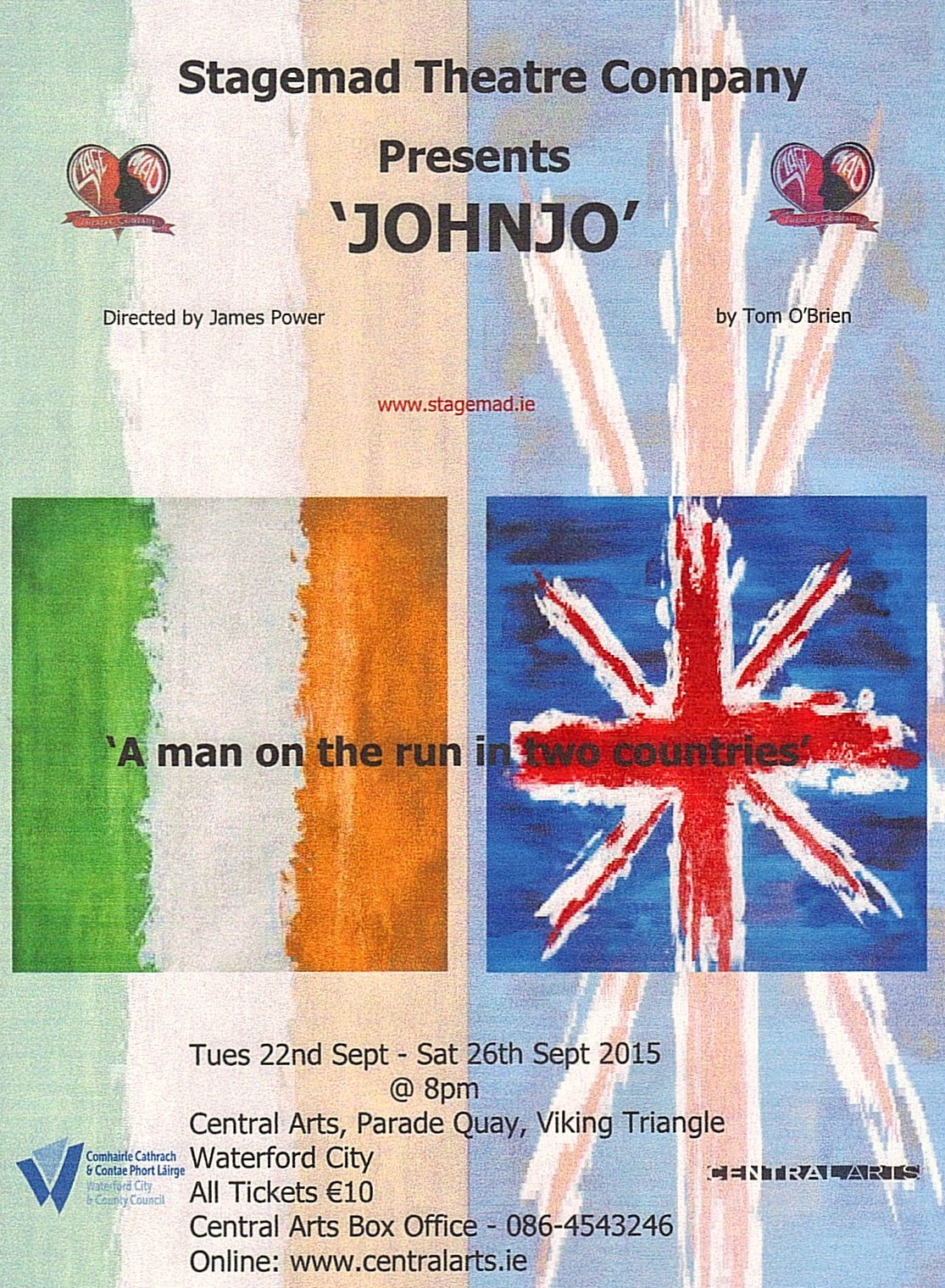
REVIEW OF MY PLAY ‘JOHNJO’, performed recently CENTRAL ARTS, JORDAN’S LANE WATERFORD

03-08-2015 14;05;03 

A View from the Green Room.

Pat McEvoy.

Arts Correspondent..WATERFORD NEWS & STAR

DISTURBING ‘JOHNJO’ AT CENTRAL ARTS.

Johnjo McGrath enters singing ballad of The Rocks of Bawn and you just know that there is a story to be told. It was a favourite of his father who barely knew the words, or the notes, if the truth be told. A small landholder of twenty acres on the Comeraghs of which only five were arable, he carried ancient grudges around like boulders. Clearing land that was full of furze, rock and limestone, he cursed his circumstances and drank a lot of whiskey to dull the pain.

He references Crotty the highwayman and understands the shared experience of disenfranchisement. He curses the Curraghmores and their acres of lawns that would have fed the bellies of half-fed cattle. Not that he had too many of those. It’s the sense of privilege and entitlement about the Curraghmores that gets to him. It eats away at him and he sees no shame in stealing the odd sheep of theirs and selling it on to slaughter. He feels dispossessed and evicted from his land and blames it on the greed of the Anglo-Irish who never had enough.

A selfish father with a grievance, he drank all he had and when he drowned himself, Johnjo had to sell the bullock to meet the funeral expenses.   With only £2-10 the mother mortgages the land and moves into the town. A knife-incident leaving a man badly wounded, forces him to flee and it’s the boat in wartime for Johnjo.

Grim times. Working on the lump, with an array of identities to avoid detection, it’s a grim and lonely existence. Kavanagh’s lines of the women who love only young men ring in the ear of the aging man who moves between damp and over-crowded doss-houses while building the motorways. The gangers are always the same. Elephant John is a tough task-master who can really dish it out. And it’s always Paddy. Never Johnjo. Still no matter when you’re on the lump. The names tumble our like tourist dishcloths…Tom Dooley…Roy Rogers…Gene Aughtry…Donald F****in’ Duck.

But a life without children. And a wife. Before he knows it, he’s fifty. It’s been an empty existence claims Johnjo but odd facts begin to pop out from the coiled spring of resentment. Sexual ambiguities surface. He prefers the company of men. Their smell. Their friendship. A band of building brothers. It’s a world of sexual compromise and secrets hidden from even himself.

He hates Bannagher, the jumped-up Irish boss who also owns the pub in Cricklewood where the wages are paid. He only pays by cheque and charges 5% on cashing cheques for subbies who he knows can never have a bank account. When a trench collapses killing Johnjo’s only friendKennedy because of poor scaffolding, Johnjo settles accounts with Bannagher in the old time-honoured way of blood-payment.

Eamon Culloty is excellent as the spiteful-regretful-sexually-ambivalent Johnjo. In what was once a best suit, he brings the whole range of despised Paddy to the stage. It’s a performance that’s always highly charged and directed with great sympathy by James Power. The emptiness of a wasted life is what remains with you after the performance. There’s nothing simple about a performance that seems to constantly search for answers and, perhaps, other ways to have gone about his business. His father’s son, he doesn’t get his sense of dispossession from the ground. He doesn’t blame the father and scoffs at Larkin’s line: they f**k you up, your mum and dad’. ‘No’ Johnjo declares ‘I f**ked them up’.

Tom O’Brien’s writing always seems to drive Johnjo on to a conclusion based on the navvies’ experience.  His wisdom is bought at a price that no one  should really have to pay. O’Brien lays Paddy’s experiences in post-war Britain bare…lodgings in damp rooms crammed with other Paddies trying to get by. Weekends trying to dull the pain of existence through drink and then looking for a sub on Monday to get through the week.

Great to see Waterford playwright Tom O’Brien’s work on a Waterford stage. Let’s see more of it.

GILMARTIN

08-07-2015 11;15;21

DON’T MISS!

FREE ADMISSION

PENTAMETERS THEATRE, SUN 19th JULY @5pm

(50 yards from Hampstead Tube Station)

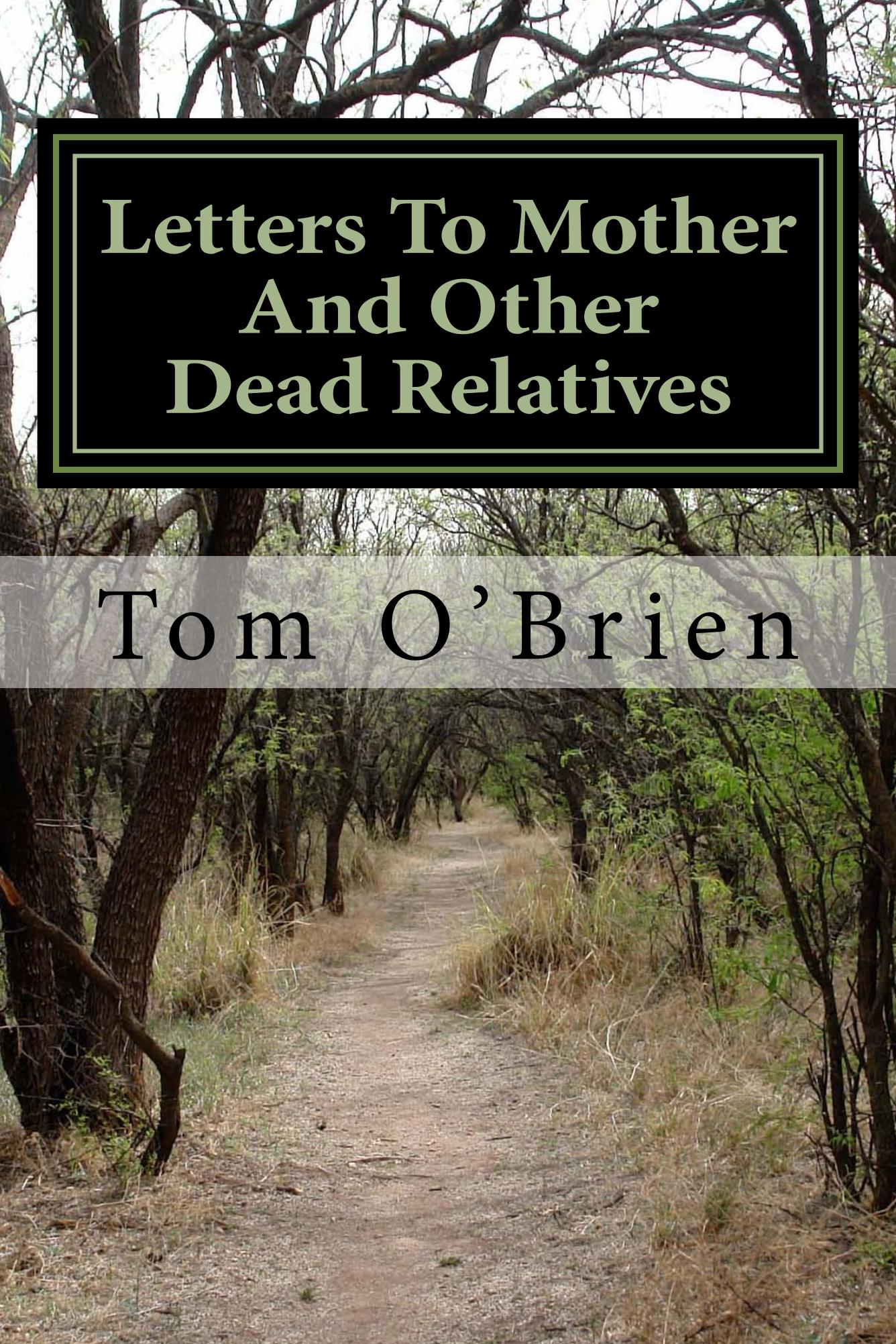
LETTERS TO MOTHER AND OTHER DEAD RELATIVES -extract


LETTERS TO  MOTHER AND OTHER DEAD RELATIVES – extract

Dear Mother,
There weren’t too many occasions when I pleased you in life. My fault not yours, because we both know that I wasn’t what you would call ‘a dutiful son’. I probably pleased you when I got married, and when I gave you your first grandchild, but I think I pleased you most when I became an Altar boy.
I imagine you saw it as a kind of status symbol: because when other mothers boasted ‘my son is going to De La Salle College’, or ‘has a place in the Christian Brothers’, you could now reply ‘my son is an Altar boy’ with a certain amount of pride. And there weren’t that many of us in the vicinity – no more than a handful – which made it all the more gloat-worthy.
Even the Master acknowledged our special status; taking us up to the church several times a week after school for rehearsals before letting us loose on our first Sunday. He took the part of the priest himself; although he didn’t ‘gown up’ for the role. But I guess Fr. Sinnott, the parish priest, would have viewed as sacrilege the idea of somebody rummaging around in his wardrobe. Still, we were put through our paces until we had mastered our roles; bell-ringing, bringing the water and the wine, and, of course, learning to chant the responses in the appropriate places. I can still recite chunks of Latin after all these years – and I still don’t know what they mean.
In due course I discovered the pleasures of wine-drinking. Thomas K and myself usually served together, and as altar boys were responsible for filling the jugs with the water and wine to be used during the Mass. When the parish priest officiated, very little water but nearly all the wine would be used. However, with other priests it might be the other way round, and we were often able to transfer some of the wine to a spare vessel we kept concealed in a recess, topping up the priest’s jug with water.
We returned later and retrieved the wine, then sat amid the gravestones drinking it. Sometimes it made your head spin, and when we added the occasional Woodbine that I had fecked from your box on the mantelpiece over the fire in the kitchen, everything started to revolve. Trees, poles, even the gravestones; whirling around so fast you had to hang on tightly to something for fear of taking off.
Being an Altar boy had other rewards too; particularly when we ‘officiated’ at weddings, funerals and christenings, where, afterwards, you could guarantee that several shiny half-crowns or maybe even a ten shilling note would be pressed into your greasy little palm. Not that I depended entirely on these fairly infrequent occasions; I quickly discovered that the collections during Sunday Mass offered a steady source of income. I am sure you will recall that when the filled collection boxes were placed by the Altar rail it became our job to take them to the sacristy and transfer the money into the bags waiting there. Once inside, I found it quite an easy task to deflect some of the coins into my own pocket. And afterwards I was able to stuff myself with Rollos, Crunchies and bags of Tayto’s on the proceeds. I wonder if it ever crossed your mind that your very own ‘God’s little helper’ had become a thief?
Not all special occasions paid off, however. Do you remember the time that M’s latest child was being baptized and she couldn’t come into the service because she hadn’t been churched? I always thought that being churched was the result of some serious transgression and for many years I wondered what M had done. It wasn’t until much later that I learned it was a purification ceremony that the church carried out on women who had given birth. This is what I read.
‘The woman who has just had a child must first stand outside the church door and only when she has been solemnly purified by sprinkling with holy water and the prayers of the priest is she led back into the church’.
Apparently it goes back to the middle ages when the church decided that women who had given birth were unclean and therefore had to be ‘cleansed’. I had often seen women before, dressed solemnly in black, kneeling in the vestibule at the back of the church after Mass, waiting for the priest to come and attend to them, but it never occurred to me that the church was punishing them for having children.
I still remember how ashamed you all looked when the priest said the baptism couldn’t take place until M had been purified, and you all trooped away to Cullinanes Pub to put down the half hour wait. I suppose you had ‘a small sherry to settle your nerves’.
I had the task of following the priest about with the vessel of Holy water. He placed a lighted candle in M’s hand, and recited the Gloria Patri and the Kyrie as well as the Our Father before sprinkling her with Holy Water and inviting her into the chapel with the words,
‘Enter into the temple of God, that though mayest have eternal life’.
However, he made sure she was veiled before letting her pass, and I have since read that women who refused to cover their heads were often ex-communicated.
I think this was one of the few occasions where no shiny half-crown changed hands.
I never stopped to wonder at the time why there were no Altar girls. I suppose it was to do with the Church’s attitude to women even then (this was the late 1950’s) as exemplified in the ‘churching’.
Thank God things have changed a bit since my youth.
Your loving son
Tom

available in paperback & ebook on Amazon

HISTORY LESSONS AGAIN

HISTORY LESSONS AGAIN

Ring of Kerry, Lackendaragh                                                                                                                                            Fachta Finn and Gougane Barra                                                                                                                                       Ollam, Piper, Beann a Ti                                                                                                                                                         Farmer, Fiddler and Land-Lease                                                                                                                                          Viking, Norsemen and Wild Geese                                                                                                                                     Erimon and Fionn Macool                                                                                                                                                        De Danann and No Home Rule

Clonmacnois and The Dail                                                                                                                                                        Men of Erin, Fianna Fail                                                                                                                                                       Democrats and Labour too                                                                                                                                                   Gombeen men, the Dublin Zoo                                                                                                                                        Loonies, Moonies, Lords and Serfs                                                                                                                                         Poets, Painters, Suffragettes                                                                                                                                                Cowboy Pictures, Travelling Shows                                                                                                                                     Ceoltas Dancing, Frightening Crows

Tyrone, Tyrconnell, Red Hugh and Owen Roe                                                                                                                    Cromwell, Robert Emmett, Dev and Strongbow                                                                                                                   Pearse, Kevin Barry, Colm Cille, Maud Gonne                                                                                                                            St Patrick, St Brigid, Mac Murrough, Wolf Tone

Aonach, Feis, Connemara                                                                                                                                                 Irelands Own and Hill of Tara                                                                                                                                              Rock n Roll and fireside stories                                                                                                                                               Sorse Eireann and Mickey Magories                                                                                                                                        The Coleen Bawn, O’Donnell Abu                                                                                                                                  Leprechauns and Faeries too                                                                                                                                         Bloody Sunday, Black and Tans                                                                                                                                             Easter Rising, Bobby Sands                                                                                                                                                   Oisin, Cormac, Tigernach                                                                                                                                                   Cashel, Cratloe and Armagh                                                                                                                                                 The Hills of Tullow, Conor Pass                                                                                                                                             Sarsfields Ride and Dorans Ass                                                                                                                                            The Croppy Boy and Ninety Eight                                                                                                                                       Sassanach and Fenian blade                                                                                                                                                  The Clipper Carlton, Dicky Rock                                                                                                                                               St Stephens Green and Glendalough

Kilmainham, Kilmichael, Kilwarden, Kinsale                                                                                                                       Dungannon, Dunmore, Enistymon, Rathkeale,                                                                                                                   Fedelm, Eithne, Aofi, Kathleen                                                                                                                                               The Shamrock, the Harp, the Flute and Crubeen

Master McGrath and Brian Boru                                                                                                                                         Famine, Firbolgs, the H Blocks too                                                                                                                                        Ard Ri, Mountjoy, Parnell and Rynanna                                                                                                                                Step-dancing, Brian Boru, Big Tom and Setanta

Tir Na Nog, the Galway Blazers                                                                                                                                             Bord Na Mona, Macs Smile razors                                                                                                                                       Mummers, Druids, Unionists                                                                                                                                        Catholics, Jews, Adventists                                                                                                                                                     Malin Head and Poitin stills                                                                                                                                                    Ikes and Mikes, the Book of Kells                                                                                                                                         Shannon, Suir, Boyne and Nore                                                                                                                                            The Gallowglass and Take The Floor

Blackleg, Wrenboy, Blackshirt, Whitethorn                                                                                                                         Whiteboy, Boycott, Blueshirt, Blackthorn                                                                                                                             Plantation, Emancipation, Emigration, Liberation                                                                                                                O’Connell, O’Brien, O’Hanlon, One Nation                                                                                                                     Cuchullian, Rebellion, the Taylor and Ansty                                                                                                                                B Behan, O’Casey, Riverdance and Planxty                                                                                                                         Sean T, Mick Del, Sean Kelly, Glenroe                                                                                                                                James Joyce, Christy Ring, Arkle and Mick’O

IRA, BBC                                                                                                                                                                               UVF, RTE                                                                                                                                                                                 IRA and UCC                                                                                                                                                                            LDF and IRB                                                                                                                                                                             ICA and ESB                                                                                                                                                                          GAA and C of E                                                                                                                                                                Saints and sinners                                                                                                                                                                  C’est la vie                                                                                                                                                                             Everyone is you and me.


THE CROWD SHOUT OUT FOR MORE

THE CROWD SHOUT OUT FOR MORE

I never thought I’d say

That Ireland is to me

Just another piece of ‘real-estate’ today;

The place where we murdered rabbits

On nights both windy and dark

Giving them that old one-two

With a rigid hand behind the neck;

The place where we captured hares

For coursing in the glen

The blood coursing wildly through our veins

As Morrisseys lurcher

Swept them up from behind – again

The place where Mass was said

And Politics pled

On Sunday mornings

Outside churches

While inside, the sermon was read;

The little man was important then

And favours done, or causes won.

Were little enough

To cause much concern to anyone

Not any more

Now that the greedy guts hold all the floor

And all you hear is rampant cheers

And raucous shouts for more

And more…

And more…

And more…

LETTERS TO MOTHER AND OTHER DEAD RELATIVES (extract)

Letters_To_Mother_An_Cover_for_Kindle

available in paperback or ebook on Amazon

Dear Mother,

We never had much to say to each other when you were alive. I suppose that had a lot to do with you being grounded in the tranquility of rural County Waterford, while I misspent my youth on the mean streets of that area of London often referred to as County Kilburn. Even when we did speak it was only in platitudes; nothing of importance was ever touched upon. Mainly, I assumed, because nothing of importance had ever happened in our family’s history. So the chances of you surprising me from beyond the grave were very remote indeed.

It began with enquiries about your favourite son, John. Telephone calls to friends and

neighbours, even to the Parish Priest in Newtown. Nosing around, you would call it. Eventually the caller phoned John himself, which is how I became involved.

Apparently we were the beneficiaries of a legacy. A substantial sum of money was laying in British Government coffers, the trail of which led back to our paternal grandfather, Tom, and we were the next in line. Nobody ever spoke about grandpa Tom; Why was that?  And now that I think of it, why is grandpa buried in one parish – Newtown – and grandma in another – Ballyduff? And why did father scrupulously care for grandma’s grave, and not grandpa’s?

But back to the legacy. There was a catch – there always is – the caller required us to sign a contract giving him 33% of the estate before revealing details to us. As I happened to consider that excessive for a ‘finders fee’ I began my own investigations on the internet.

As far as I could see, the only family member who it could possibly be was Aunt Margaret.

When I had last seen her ten years ago, she was already an old woman, living in poverty in Lewisham. (I know you always said she had loads of money, but if you had seen how she lived then you would have changed your mind)

Anyway, after several hours of queries to Ask Jeeves and co, I came across a British government website called www.bonavacantia.co.uk  I typed in a name and there it was in black and white! Margaret O’Brien…. Lewisham, died intestate 2005. Estate £XX,000 How well you knew her!

But of course you didn’t really. Nobody did. Not even my father – her own brother. He never spoke about her.  Why was that? She left Waterford in 1947 and was never seen by any member of the family again, apart from myself. Oh, I know you wrote her the occasional letter and she sent parcels of used clothes to you. ‘Her cast-offs’, you called them, before burning the lot.

What was it that caused her to go away and never come back?

She came to visit me in Kilburn shortly after Karen was born – was that your doing, giving her my address? – And we kept in contact until I moved away from the area. She liked the idea of having a niece, but I found her a strange, secretive woman.

When I last saw her she was housebound, living in a dingy council estate in Deptford. And given to calling me ‘Captain’ – because I don’t think she remembered who I was any more. After that I forgot about her.

To establish claim to the estate I have had to furnish various documents; birth, marriage, death etc. Which is how I learned that my father and Aunt Margaret weren’t the only children born to my paternal grandparents. There were three other children, John, James and Catherine. What

happened to those uncles and aunt? Father never spoke of them. They are not still alive as far as I can establish, but neither have I yet ascertained where and how they died and where they are buried.

But you, mother dear, served up the biggest surprise of all. On your marriage certificate, it says FATHER UNKNOWN. Why, in my childhood, did I never realize that your mother was unmarried? Or query the fact that your father had never been around. Oh, there was a man about the house – your mother’s brother Mikey – and maybe I subconsciously associated him with being  your father. Mikey, with his wooden leg -he had lost the real one fighting with the British Army in Flanders – lives on in my memory, and I can still recall trying to remove my leg as he did his, and wondering why I couldn’t. I almost wish now that he had been your father.

I have since learned that you did know your father. He was a friend of Mikey’s who had also joined the British Army, but had been killed in the same battle that had seen my granduncle lose his leg. Killed before he could make an honest woman of your mother.

Killed before he could respectably be put down on your wedding certificate as your father.

You never spoke about any of this. Not to me, anyhow. Was this what made you melancholy in your later years? The thought of your mother living all her life in her little thatched cottage in Grenan, the man she loved lying in an unmarked grave, lost forever in those green fields of France?

I think it’s sad that I find you more interesting dead than I ever did when you were alive.

Your loving son, Tom

  Continue reading

JOHNJO – an extract

MY NEW PLAY – JOHNJO – IS NOW AVAILABLE IN PAPERBACK ON AMAZON

download

JOHNJO EXTRACT

 scene one

A darkened stage. We hear the sounds of a busy building site.  Then a voice…

VOICE:     Jaysus, Blondie…that’s a…a…

Then another sound – an explosion.

Silence.

The light’s come up, to reveal JOHNJO sitting on a rock on a hill.  The hill looks down on some windswept, craggy fields, and, in the distance, faint outlines of farm buildings (unseen).  Johnjo is in his fifties, weather-beaten, but well-dressed…(suit, polished shoes etc) He is singing softly at lights-up.


JOHNJO:                               (THE ROCKS OF BAWN)

Come all ye loyal heroes and listen on to me.

Don’t hire with any farmer till you know

what your work will be

You will rise up in the morning

from the clear daylight till dawn

And you never will be able

For to plough the rocks of  bawn

My father was always singing bits of that song.

I don’t know, maybe he didn’t know any more of it,

but those are the only words that stick in my mind…

(pause)

I suppose, though, they had a certain ring…

Plough…Rocks…Bawn….

(he gets up and looks around)

I mean, look at it…

More rocks than bawn…

By God, if I had a penny for every stone we picked…

For every furze bush we cut down…

(imitates his father)

Fifty acres, boy…and five of them is a hill.

What good is a lump of limestone to a farmer?

You can’t feed beasts on rocks. By God, if I

had my way, I’d blast the whole lot to kingdom

come…

(laughs, sings  I AM A LITTLE BEGGARMAN)

I am a little beggerman

and begging I have been

For three score and more

In this little isle of green

With me sikidder-e-idle- di

And me skidder-e-idle-do

Everybody knows me

By the name of Johnny Dhu.

That was his favourite song

He would sometimes sit me on his knee…

Johnjo ‘hears’ a woman’s voice calling.

‘VOICE’:   Johhny, Johnny where are you?

Out there in the cold with the child!

Come on in now and milk the cows… Continue reading

DAMN YOU ENGLAND

article-2026843-03D065A40000044D-84_634x410

One of the best books I have read on the theatre, and on the people who people it,
is John Osborne’s DAMN YOU ENGLAND. He doesn’t suffer fools gladly.
Surprisingly, he has plenty of time for Brendan Behan. Here he is on their first meeting;
“Brendan Behan lurched into my life early one Sunday New York morning. Pounding on my hotel
room door. ‘Is anyone in this fucking cathouse alive?’ he roared. ‘My name is Brendan Behan.
I don’t smoke, I don’t eat and I don’t fuck, but I drink. You can always tell the quality
of a country by two things;its whores and its bread. And neither of them are any fucking good here’.
Brendans life was a ballad, the wild outpouring of a pure, forgiving heart. Who is there in Ireland
or England to take up his matchless song now?