ADAPTING A BOOK TO A PLAY
Brian Harding is an alcoholic. He is in his late sixties now and had his first drink in 1953, on Coronation Day. Sixty years on he is still drinking daily; it is killing him, but as he says ‘if I stop now it will kill me quicker’.
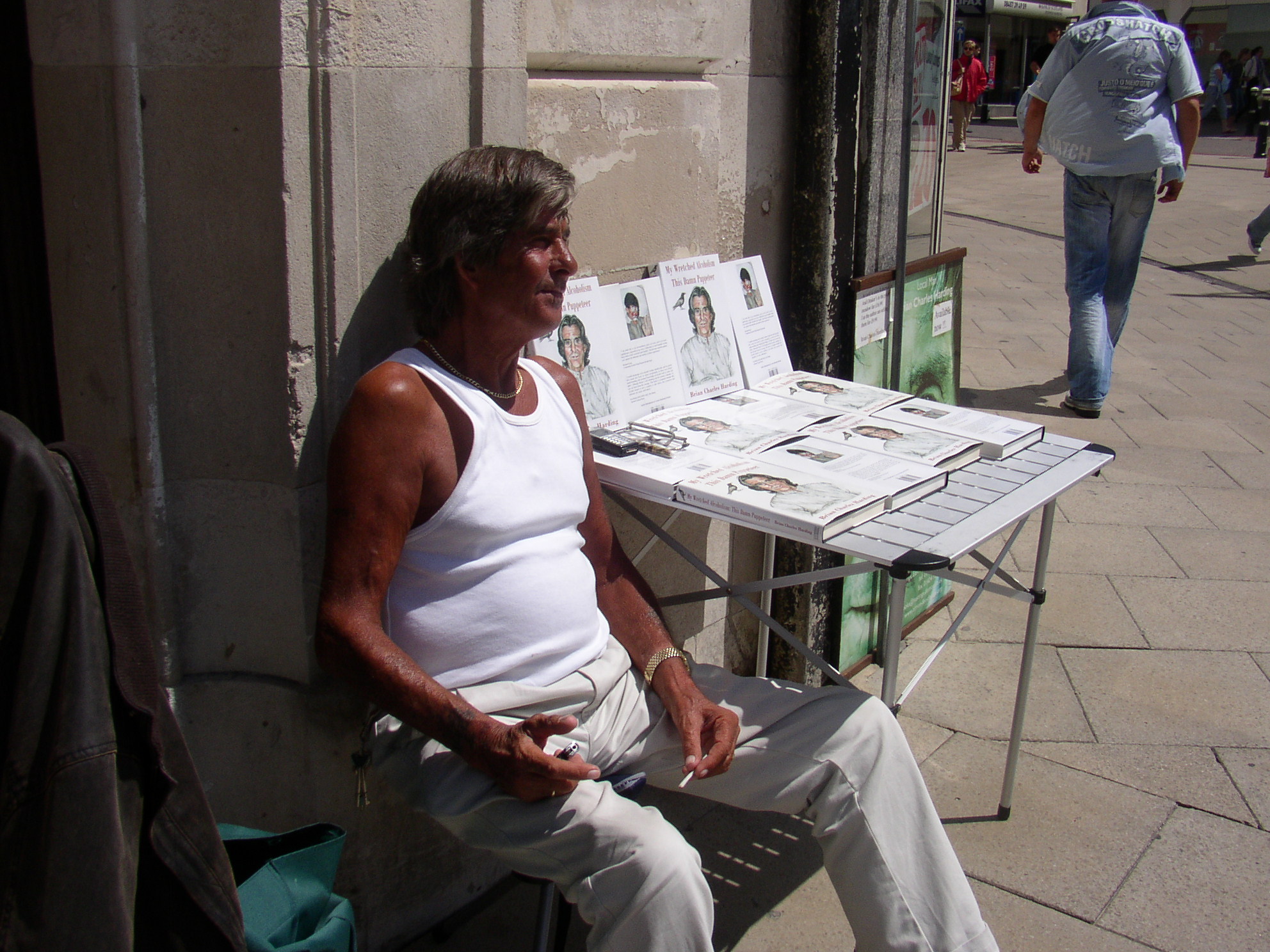
I first met Brian a number of years ago; he was selling copies of his book ‘My Wretched Alcoholism – This Damn Puppeteer’ outside Natwest Bank in Hastings town centre, and I was persuaded to buy a copy.
It was a harrowing read, dealing as it did with Brian’s life as it spiralled ever downwards as he became addicted to drink, but I felt it was totally honest account , and he had portrayed himself warts and all. It appealed to the playwright in me; I felt it would make a very good stage play and felt a compulsion to adapt it. I spoke to Brian and he agreed, provided I promised him a production within a year. I promised – easier said than done! – but to be honest at this stage I had no idea how I would accomplish it. Still, I wanted Brian’s signature on that contract so I decided to worry about that little detail later!
Brian was a self-confessed street drinker, who once thought of Bottle Alley as his place of abode. It is still considered that by some alcoholics today – though it’s not nearly as bad these days – and when I visited it to get a feel for what I was going to write about I realised I had found the title for my play – Down Bottle Alley.
 Bottle Alley
In the early 1930’s Hastings tramways were ripped up to make way for a new promenade built in reinforced concrete. This double-decker promenade, which is approx half a mile long, and stretches from the Pier to Warrior Square, was the brainchild of Sidney Little, Hastings borough engineer.
The lower walkway was built in a functional style, relieved by the decorative effect of the rear wall which was faced with coloured glass from broken bottles. The glass came from the council tip, where Little discovered a veritable mountain of discarded bottles. These were broken up and incorporated into the concrete slab which makes up the real wall. Close examination shows bottle fragment with the names of local brewers of the period, and it was long before it became known as Bottle Alley. In later years it lived up to its name, being used as a meeting – and drinking – place by the street drinkers of Hastings and St Leonards.
……………..
Brian’s book began as a form of therapy and just grew until what finally resulted was a brilliant account of what it is like to be in the grip of ‘the demon drink’. His introduction included this statement; ‘I have led a wretched life, neither producing, creating or contributing anything. My affair with drink has rendered me for the most part incontinent, impotent, and without any real place in this society. I still manage to keep clean but I don’t feel it. My wife’s friends treat me politely and with a respect that I feel is guarded, and with a false affinity. False in that everyone is an ‘aholic’ of some sort or another. They have no idea. I have no point of reference as to how life would be without drink. It seems I have always been steeped in drink. I am drunk now. I quite possibly won’t finish this story’.
I also now had my opening lines. A picture began to emerge; An older Brian talking about his life to the audience; a younger, more agitated Brian re-living some of the more important highlights – or low-lights; both of them seeming to be two different people, constantly arguing, haranguing each other. And other, varied characters to tie it all together.
It would be different than the book of course; it would have to be as there was practically no dialogue in Brian’s book – and a play is comprised only of dialogue. It would still be Brian’s story, and of some of the other important people in his life, but I would have to put words in all their mouths! To do this I would need a framework; a set number of characters and events, presented in such a way that it made sense of Brian’s much more detailed examination of his life.
Some events in Brian’s story had more significance than others; His abuse as a child by his father, including urinating on him in a bath of cold water; his meeting with Lydia, a prostitute, at Charing Cross station; his marriage to his first wife Pat; his various ‘holidays’ in mental/psychiatric institutions like Heddingly; all these I re-imagined then fleshed out to give the story a dramatic impact on stage. Of course all of the wide range of characters that Brian came into contact with couldn’t be included, so I invented a couple of fictional ones which, in essence, were composites of the numerous real ones. Big Tone was one example; he is seen as Brian’s sidekick in the play, but he never existed in real life. Sally, a vagrant who inhabits Bottle Alley, is another one. But most of the events in the play did really take place.
Finding a venue was easier than I expected; I contacted The White Rock theatre and they were more than happy to have us stage it there. They were very helpful with marketing and even printed and distributed posters for us throughout the town. However, I was nervous of doing it ‘cold’ in Brian’s home town – well Brian was born in Sevenoaks but had lived for many years in Hastings and regarded it as home – so I contacted a producer friend of mine in London. John Dunne ran a theatre company called Croft Productions and he agreed to try it out first at the Irish Centre in Camden.
Brian was very excited by the idea of a play and decided to come to London for this ‘try-out’. A really big crowd turned up for the performance and it proved a big success with the audience – the most touching part of all was the sight of Brian sitting in the front row, crying his eyes out throughout the performance. We were clearly doing something right.
The big night at the White Rock turned out a most extraordinary event. Over 200 people turned up at the downstairs venue – a sell-out – and we had a question-and-answer session afterwards, with Brian, John and myself fielding questions for over half an hour. Many people confessed that the story struck home; they all knew somebody – a friend or relation – whose story it could have been. It was Brian’s story but it could have been anybody’s, anywhere – which only reinforces my belief that there are Bottle Alleys wherever you go.
This is an extract from the review written by Tony May for Hastings Town magazine;
‘What followed was….a play so brutally honest, so visually vivid and –worst of all – so terrifying real that there could be no hiding away from it…throughout the whole performance you could hear a pin drop.
James Lawes was especially outstanding. Having spoken to the real Brian beforehand I felt that his acting was utterly in time with the spirit, language and mannerisms of the man that it was unnerving. The constant shaking of the leg, the twitching hand desperate to hold onto the remnants of a fag butt, the mood swings, the physical collapses – all were carried off to a devastating effect….’
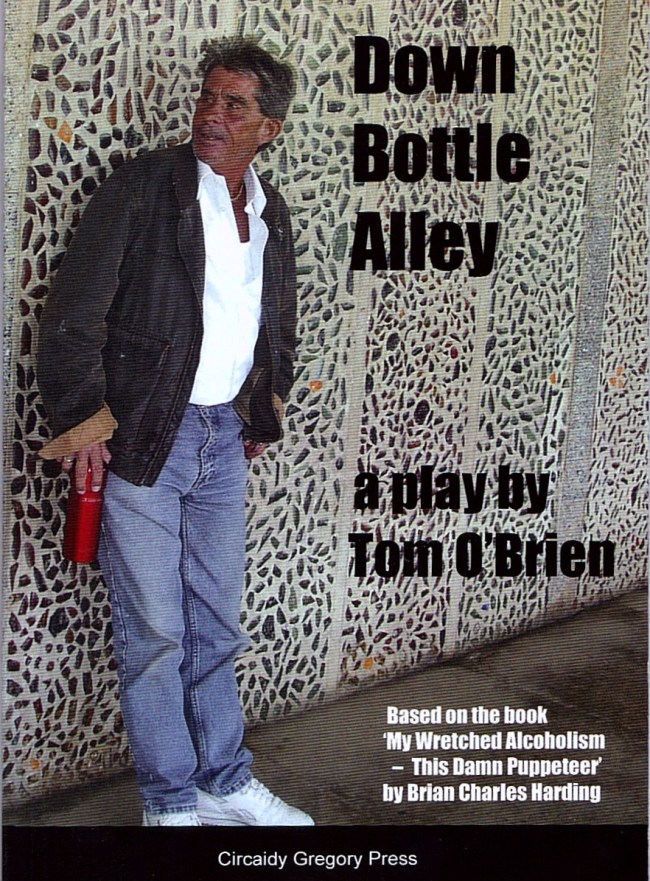
On a sad note, Brian has since died. My book of the play, shown above is available on Amazon.




 My Writing Life